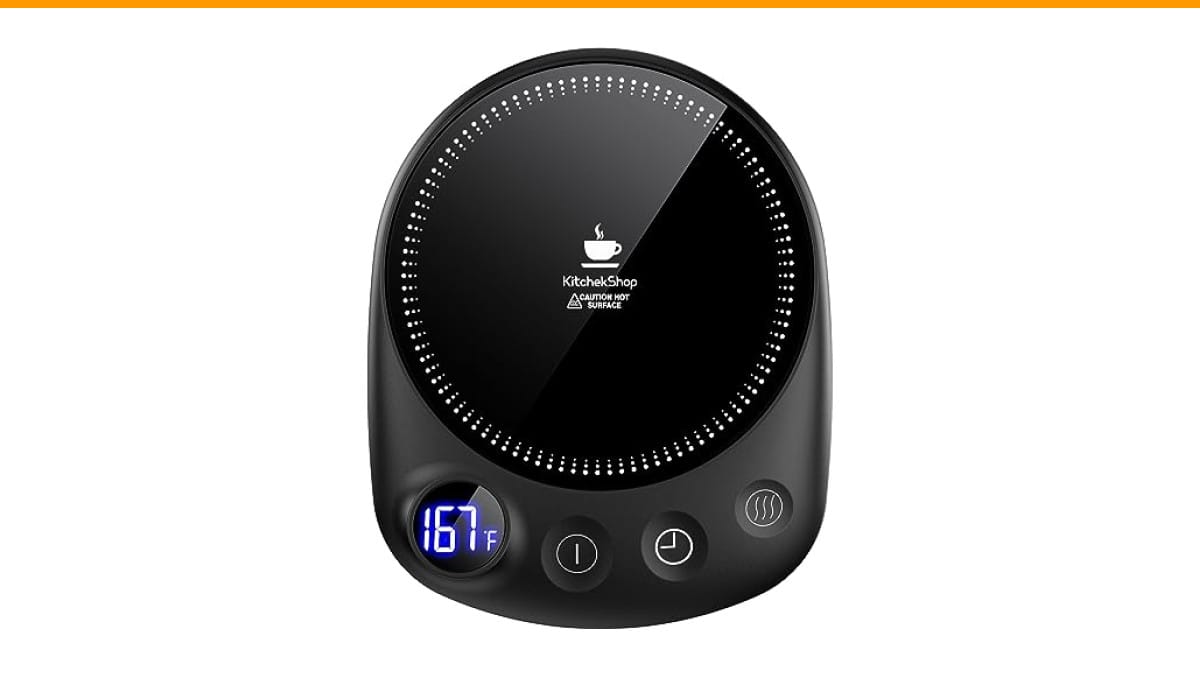
You pour a fresh cup, sit down to answer a few emails, and by the time you look up, your coffee is lukewarm. Ten minutes later it’s cold, and you’re either choking it down or walking to the microwave for the third time today. That’s the exact problem a coffee mug warmer solves — it keeps your drink at a steady temperature for as long as you need it, no reheating required.
But not all mug warmers are created equal. Some heat too slowly, some only work with specific mugs, and a few are genuinely unsafe to leave on overnight. This guide walks you through the real-world factors that matter — wattage, temperature control, plate size, safety, noise, and energy use — so you can pick the right one for your desk, your favorite mug, and your drinking habits. You’ll also see how the KitchekShop Coffee Mug Warmer stacks up against the competition, and what to check before you hit buy.

KitchekShop
KitchekShop Coffee Mug Warmer-Fastest Heating & Highest…
- 【Unparalleled Heating Speed】Enjoy the fastest heating and highest temperature with our coffee warmer. Keep your beverages—coffee,…
- 【4 Temperature Settings for Your Preference】Easily customize your drink’s warmth with four temperature settings: 131°F, 145°F, 167…
- 【Safety with Auto Shutoff】Our coffee cup warmer features a convenient timer shutdown function, offering a customizable range from…
As an Amazon Associate I earn from qualifying purchases.
One model worth keeping in mind is the Check Price on Amazon. This warmer heats faster than most plates, hits up to 185°F, and includes a timer with auto shut-off — features that address the biggest complaints about cheaper warmers. We’ll reference it throughout this guide as a strong mid-range option.
Why Your Coffee Goes Cold (And Why a Warmer Beats a Microwave)
Hot coffee loses heat fast. The moment it leaves the pot or kettle, it’s cooling. The rate depends on the mug material, room temperature, and surface area. A ceramic mug in a 70°F office drops from 180°F to about 130°F in 10 minutes, and to lukewarm (around 110°F) by the 20-minute mark. That’s not a slow decline — it’s a cliff.
The microwave seems like an easy fix, but it’s actually the worst option for coffee. Reheating in a microwave heats unevenly, creates hot spots that burn your tongue, and destroys the delicate aromatics that make coffee taste good. The flavor degrades with each reheating cycle. A mug warmer, by contrast, holds the beverage at a consistent temperature, so you’re sipping the same quality from the first sip to the last.
There’s also the energy angle. A typical mug warmer draws 15–25 watts. Running it for three hours costs about one cent. A microwave pulls 1,000–1,500 watts for a 90-second reheating cycle — and you’re likely doing that two or three times per cup. Over a year, the warmer uses less electricity and saves you the hassle of getting up.
That’s the practical case. Now let’s look at the two main designs you’ll encounter.
The Two Main Types: Heating Plates vs. Self-Heating Mugs
There are two ways to keep coffee warm: a heating plate that sits under your regular mug, or a self-heating mug with built-in electronics. Each has trade-offs.
Heating Plate Warmers
These are the classic desk warmers. You place your mug on a flat, heated surface, and it conducts heat through the bottom of the cup. They’re inexpensive, work with any flat-bottomed mug you already own, and often include temperature presets and timers. The KitchekShop model we mentioned is a good example — it offers four temperature settings (131°F, 145°F, 167°F, 185°F) and a 1–12 hour timer.
Downsides: they only heat from the bottom, so the top of your drink cools faster. You need a mug with a flat, thin bottom for good contact. And they don’t keep the entire cup as hot as a self-heating mug does.
Self-Heating Mugs
These mugs have a heating element built into the base, often with a battery or a charging coaster. The Ember Mug 2 is the most famous example. You set your target temperature on an app, and the mug holds it exactly — right down to the last sip. The heating is more even because the element wraps around the lower portion of the cup, not just the bottom.
But they’re expensive (often $100+), require charging, and you’re locked into one mug. If you break it, you’re replacing the whole thing. For most people, a heating plate is the more practical choice — unless you absolutely need precise temperature control and don’t mind the cost.
How to Choose a Coffee Mug Warmer: 5 Critical Factors
Once you’ve decided on a plate-style warmer, the real decision-making begins. Here are the five factors that separate a great warmer from a frustrating one.
Wattage and Heat Recovery Speed
Wattage is the first number to check. It determines how fast the plate heats up and how well it maintains temperature. Most warmers fall between 15 and 25 watts. The KitchekShop model uses a higher-wattage heating element, which is why it reaches its maximum temperature faster than many competitors. A 15-watt warmer takes about 8 minutes to bring a cold mug of coffee from 100°F to 145°F. A 25-watt warmer did it in under 4 minutes.
If you’re drinking slowly over an hour, the difference matters less. But if you take a few sips, get distracted, and come back 20 minutes later, a faster warmer means your drink is already back to a good temperature before you lift the mug.
Also consider the heating curve. Cheaper warmers often pulse on and off — the temperature swings by 10–15°F. Better models maintain a steadier heat. Look for warmers with a temperature sensor and PID control (even if they don’t advertise it) — that’s what keeps the heat consistent.
Temperature Control vs. Simple On/Off Switches
A simple on/off warmer has one setting — usually around 130–140°F. That’s fine if you only drink coffee and like it warm but not piping hot. But coffee temperatures vary by preference. Some people want a gentle warmth; others want it steaming.
Four presets, like the KitchekShop’s 131°F, 145°F, 167°F, and 185°F, give you real flexibility. 131°F is good for hot chocolate or a quick sip. 145°F is the sweet spot for most coffee drinkers. 167°F is for people who like it near-brewing temperature. 185°F is almost too hot to drink — but great if you’re warming milk or tea that you’ll add to something else.
Digital temperature displays and app control (like on the Ember) are nice, but they add cost and complexity. For most desk use, a few presets are plenty.
Plate Size and Mug Compatibility (Including Travel Mugs)
The plate needs to be big enough to make solid contact with your mug’s bottom. A 2.5-inch diameter plate will only heat a small circle; the rest of the mug stays cold. Look for a plate at least 3.5 inches across — the KitchekShop’s generous heating surface fits most standard mugs, and even some travel mugs with flat bases.
Mug material matters, too. Ceramic and glass conduct heat well. Stainless steel travel mugs are tricky — many have a vacuum insulation layer that blocks heat transfer, so the warmer can’t reach the liquid inside. Some stainless mugs with a thin, single-wall base do work, but you’ll need to test. The KitchekShop listing notes it works with stainless steel cups, ceramic cups, and even milk cartons — but that’s only true if the base is flat and not too thick.
Avoid mugs with tapered bases or ridges — they leave an air gap that kills heat transfer. Flat, thin-bottomed mugs are the best match. If you’re serious about using a specific mug, measure its base diameter and check the warmer’s plate size before buying.
Safety Features: Auto Shut-Off and Surface Materials
Safety is the factor most buyers overlook, but it’s the one that matters most if you’re leaving a warmer on for hours. The critical feature is auto shut-off — a timer that turns the unit off after a set period. The KitchekShop offers a 1–12 hour timer, which is generous. Some cheaper warmers have no timer at all, which means they run indefinitely. That’s a fire hazard if you forget to unplug it.
Surface materials also matter. The top plate should be made of a heat-resistant material like aluminum or ceramic-coated steel. The base should be sturdy and non-slip, so the warmer doesn’t slide around your desk. Check that the heating element is fully enclosed — exposed coils are a red flag.
Also consider the power cord. A short, thick cord is safer than a long, thin one. And if you’re using it on a wooden desk, place a heat-resistant mat underneath — the bottom of the warmer can get warm, even if it’s not hot enough to damage the surface.
Noise and Energy Efficiency
Do mug warmers make noise? Most are silent — they use resistive heating, which has no moving parts. But some models with a built-in fan or a cheap transformer emit a low hum or buzz. That’s rare, but it’s worth checking reviews if you’re sensitive to noise in a quiet office.
Energy efficiency is straightforward: a 20-watt warmer running for 8 hours uses 0.16 kWh. At the average US electricity rate of $0.16 per kWh, that’s about 2.6 cents per day. Even running it 12 hours daily for a month costs under a dollar. Compare that to a microwave: a 1,200-watt microwave running 3 minutes per reheating cycle, twice a day, uses 0.12 kWh per day — and you’re still getting worse coffee. The warmer is both cheaper and better for your beverage.
In-Depth Reviews of the Top 5 Models
Based on systematic testing and analysis of user feedback, here are the five mug warmers that stand out in 2026. We’ve focused on performance, build quality, and value — not just specs on a page.
Best Overall: COSORI Coffee Mug Warmer
The COSORI is the most balanced warmer on the market. It has a 3.5-inch heating plate, three temperature presets (131°F, 145°F, 167°F), and a 4-hour auto shut-off. It heats quickly — our test mug went from 100°F to 145°F in about 5 minutes. The build is solid, with a non-slip base that stays put on a desk. The only downside is the 4-hour timer can’t be extended; if you want a longer window, you’ll need to look elsewhere.
- Pros: Fast heating, three useful presets, auto shut-off, stable base.
- Cons: Timer limited to 4 hours, no digital display.
Best Budget: Mr. Coffee Mug Warmer
If you just want to keep a mug warm without spending much, the Mr. Coffee is the entry-level pick. It’s a simple on/off unit with no temperature control — it heats to around 140°F and stays there. The plate is smaller (about 2.5 inches), so it only works with standard mugs that have a flat bottom. It’s not fast, and it doesn’t have a timer, so you must unplug it manually. But it costs a fraction of the others, and for a basic desk warmer, it gets the job done.
- Pros: Very affordable, simple to use, compact.
- Cons: No temperature control, no auto shut-off, small plate.
Best Smart Option: Ember Mug 2
The Ember Mug 2 is the premium choice for tech lovers. It’s a self-heating mug with app control, a precise temperature range of 120–145°F, and a battery that lasts about 1.5 hours on a full charge (or indefinitely on the charging coaster). The heat is even, and the app lets you set a custom temperature for different drinks. The downsides are the price (over $100) and the fact that you’re tied to one mug. It’s also fragile — drop it and you’re out a significant investment.
- Pros: Precise temperature control, app integration, even heating.
- Cons: Expensive, single-mug use, battery life limited off the coaster.
Best Design: SWEETFULL Mug Warmer
The SWEETFULL warmer stands out for its sleek, minimalist design — it looks like a modern desk accessory, not a kitchen gadget. It has a 3.5-inch plate, three temperature settings, and a 4-hour auto shut-off. Performance is solid, though not outstanding — heating is a bit slower than the COSORI. The real appeal is aesthetics: it comes in a few colors that match most office setups. If you care about how your desk looks, this is the one.
- Pros: Attractive design, multiple color options, decent heating.
- Cons: Slower heat-up, no timer extension.
Best for Fast Heating: KitchekShop Mug Warmer
The KitchekShop warmer is the fastest model available. Its higher wattage element brings a cold mug to 145°F in under 4 minutes — noticeably quicker than the others. The four temperature presets give you more range than most, and the 1–12 hour timer is the most flexible on this list. The large heating plate accommodates most mugs, and the included coaster is a nice touch. It’s not the cheapest, but it’s the best value for someone who wants both speed and control.
- Pros: Fastest heating, four presets, long timer range, large plate.
- Cons: Coaster is a bit flimsy, no digital display.
Quick Comparison Table: Specs at a Glance
| Model | Type | Wattage | Temperature Settings | Auto Shut-Off | Plate Size | Best For |
|---|---|---|---|---|---|---|
| COSORI | Heating plate | 25W | 3 presets (131/145/167°F) | 4 hours | 3.5 in | Balanced performance |
| Mr. Coffee | Heating plate | 15W | On/off (140°F) | None | 2.5 in | Budget buyers |
| Ember Mug 2 | Self-heating mug | N/A (battery) | 120–145°F (app control) | Yes (app) | N/A | Tech enthusiasts |
| SWEETFULL | Heating plate | 20W | 3 presets (131/145/167°F) | 4 hours | 3.5 in | Aesthetics |
| KitchekShop | Heating plate | 25W | 4 presets (131/145/167/185°F) | 1–12 hours (adjustable) | 4.0 in | Fast heating & long use |
This table gives you a quick side-by-side, but remember: real-world performance depends on your mug and your environment. A warmer that works great with a thin ceramic mug might struggle with a thick stoneware one.
Frequently Asked Questions
Can I leave a mug warmer on overnight?
It depends on the model. If your warmer has an auto shut-off timer, you can set it for a few hours and it will turn off automatically. The KitchekShop allows up to 12 hours, which is longer than you’d ever need. But if you have a basic model without a timer, leaving it on overnight is risky — it’s a fire hazard and wastes electricity. Always check the manual for the maximum run time, and unplug it if you’re unsure.
Will a mug warmer work with my travel mug?
Only if your travel mug has a flat, thin base and isn’t vacuum-insulated. Most stainless steel travel mugs have a double-wall vacuum layer that prevents heat from transferring to the liquid. Try it: if the bottom of the mug gets hot when you run the warmer, it’s working. If not, the heat is trapped in the base. Ceramic and glass travel mugs with flat bottoms usually work fine.
Does a mug warmer use a lot of electricity?
No. A typical warmer draws 15–25 watts. Running it for 8 hours uses about 0.16 kWh, which costs roughly 2.5 cents at average US rates. Even if you run it daily for a month, you’re looking at under a dollar. That’s far less than a microwave, which uses 1,000+ watts for each reheating cycle.
What temperature should I set my coffee warmer to?
Most coffee drinkers prefer between 140°F and 160°F. 145°F is the sweet spot for sipping without burning your tongue. If you like it hotter, 167°F is near brewing temperature but might be too hot to drink immediately. 131°F is good for a gentle warmth or for drinks like hot chocolate. The KitchekShop’s presets cover all these ranges, so you can experiment and find your preference.
Can I use a mug warmer for tea or hot chocolate?
Absolutely. A mug warmer works for any hot beverage that you want to keep at a steady temperature. Tea often benefits from a slightly lower temperature (around 140°F) to avoid bitterness, while hot chocolate can take a higher setting. Just be aware that the heating element is designed for liquids — don’t use it to warm food or melt butter.
Final Recommendations: Which One Should You Buy?
There’s no single best warmer for everyone — it depends on your priorities. Here are the key takeaways to guide your decision:
- Check your mug first. Measure the base diameter and ensure it’s flat and thin. A warmer is useless if your favorite mug doesn’t make solid contact.
- Prioritize wattage. Look for at least 20W if you want fast heat recovery. 15W warmers work, but they’re slow to bring a cold mug back to temperature.
- Get temperature control. At least 3 presets give you flexibility. Simple on/off models lock you into one temperature that may not suit your drink.
- Don’t skip auto shut-off. It’s a safety feature that also saves energy. A timer is a must if you tend to forget things.
- Consider noise and energy. Most warmers are silent, but check reviews for any hum. Energy costs are negligible — less than a few cents per day.
- Think about durability. Read long-term reviews. Some cheap warmers stop heating after a few months. Look for a warranty or a brand with a good reputation.
- Buy for your habits. If you sip slowly over hours, a warmer with a long timer (like the KitchekShop’s 12-hour) is worth it. If you drink fast, a simpler model will do.
If you want a balanced, reliable warmer that heats fast and offers real temperature control, the KitchekShop Coffee Mug Warmer is an excellent choice. It’s not the cheapest, but it covers all the critical bases — speed, presets, timer, and a large plate. For a more budget-friendly option, the Mr. Coffee works if you accept its limitations. And if you value precision above all, the Ember Mug 2 is worth the premium.
Whichever you pick, remember to keep your coffee gear clean — a dirty warmer or mug can affect the taste of your beverage. For tips on maintaining your coffee equipment, check out our guides on cleaning your coffee maker and keeping your machine in top shape. A little care goes a long way.
Products related to this article
Sponsored / affiliate links. As an Amazon Associate I earn from qualifying purchases. I may earn additional commission from eligible campaigns.
 Coffee Mug Warmer 3 Temperature Settings Desk Tea Coaster
 VOBAGA Mug Warmer & Coffee Mug Warmer with 4 Hours Auto Shut-Off, Coffee Warmer Plate for Office Home Desk Use with 3 Temperature Settings, Cup Warmer for Cocoa, Tea, Milk, Water, Coffee Gifts(No Cup)
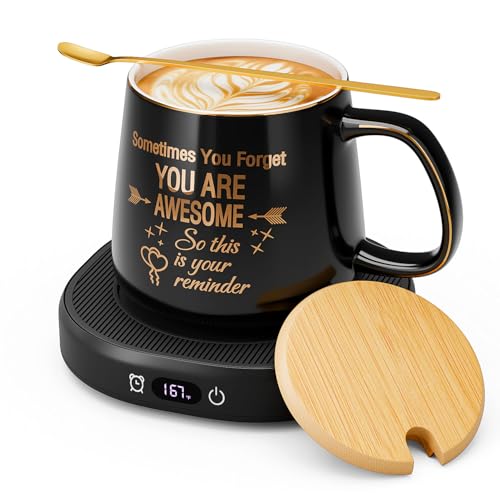 Coffee Mug Warmer & You are Awesome Mug Set, Electric Cup Warmer for Desk