You pull a shot that looks perfect, but it tastes sour. You dial finer, and the next shot chokes the machine. The problem isn’t your technique. It’s the stale coffee oil and ground-up fines stuck inside your grinder. That buildup changes the grind size, slows the motor, and makes every shot taste like last week’s forgotten cup.
This guide covers what actually works to keep your espresso grinder consistent. You’ll learn a daily routine that takes 10 seconds, a weekly check that catches problems early, and a monthly deep clean that restores like-new performance. I’ll also bust a few myths that lead people to ruin their burrs or waste time on useless rituals.
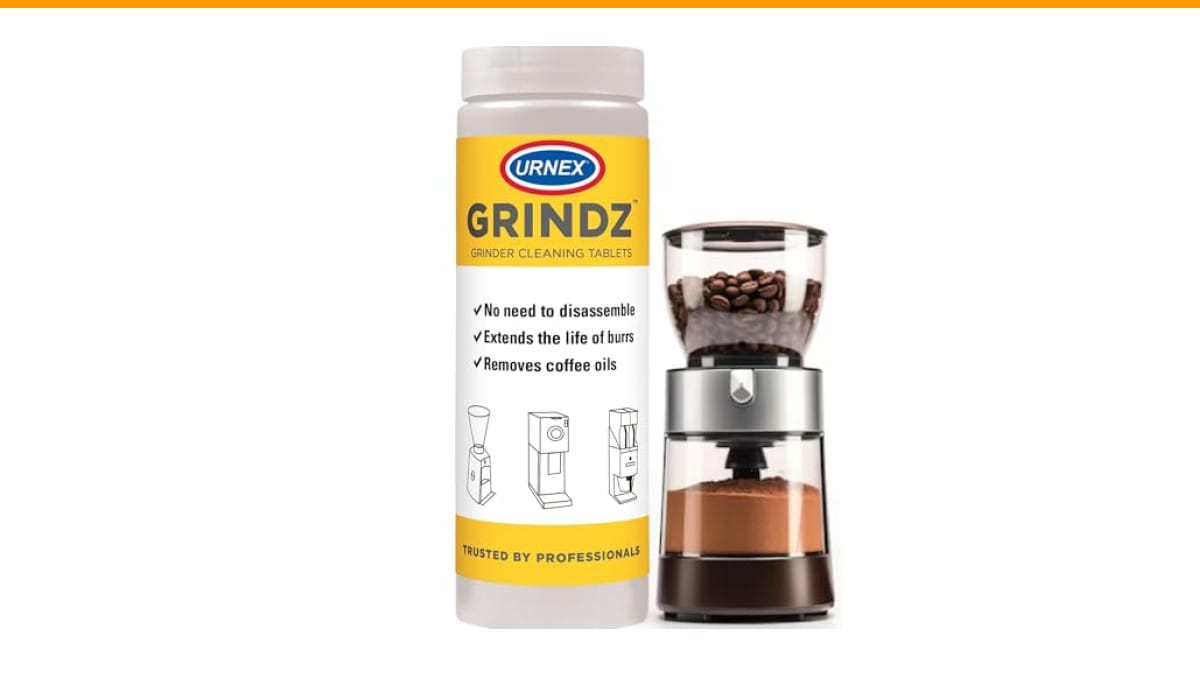
Urnex
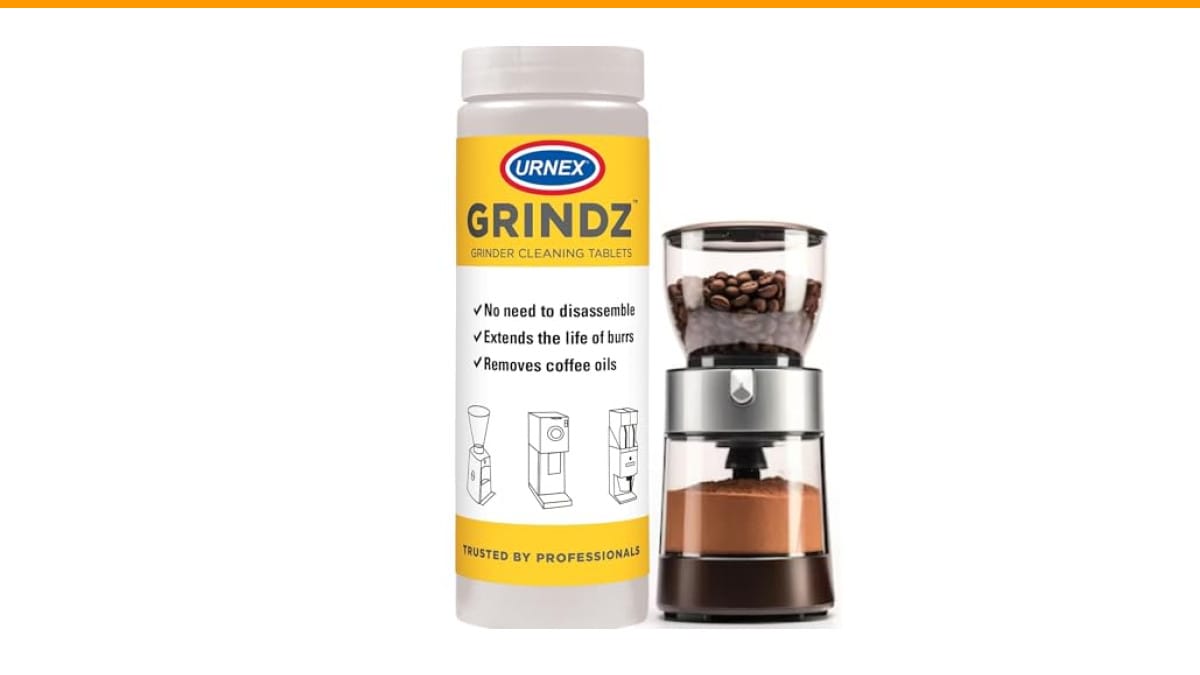
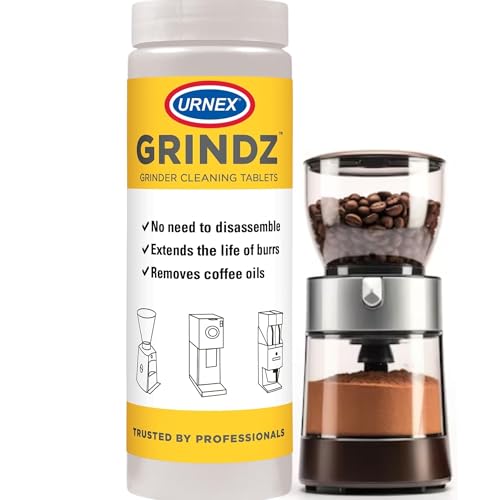
Urnex Grindz Professional Coffee Grinder Cleaning Tablets…
- Removes coffee residue and oils in standalone coffee grinders (not for super automatic espresso machines)
- Patented, all-natural, food safe and gluten-free tablet absorbs and loosens coffee grounds
- Effectively cleans grinders without disassembling burrs or casings
As an Amazon Associate I earn from qualifying purchases.
You don’t need to disassemble your grinder every week. You don’t need special tools. You need the right habits and a few products that do the heavy lifting.
One product that makes the monthly clean dramatically easier is Urnex Grindz Professional Coffee Grinder Cleaning Tablets. These food-safe tablets absorb and loosen the oils and residue that stick to burrs, so you don’t have to brush every tooth by hand.
Myth #1: You Only Need to Clean When the Grind Looks Dirty
Most people wait until they see clumps or smell rancid coffee. By then, the damage is already happening. Old oils go rancid and coat the burrs, which makes the grind less uniform. Fines stick to the chute and block the path, so your dose weight changes shot to shot.
That’s why you need a schedule, not a visual cue. The rule I use: daily purge, weekly brush, monthly tablet. It sounds like a lot, but each step is quick.
Daily purge means running a few grams of fresh beans through after your last shot. This pushes out the oily fines that stay in the chute. It’s the single best habit for keeping your grinder consistent. Do it while the grinder is still warm, because warm parts don’t let oils harden as fast.
Weekly brush-down takes two minutes. Remove the hopper and use a stiff brush to sweep the burr chamber, the chute, and the exit spout. You’ll be surprised how much powder comes out even after daily purging.
Myth #2: You Can Use Rice or Bread to Clean Your Grinder
People recommend raw rice to clean grinders because it’s cheap and absorbs oils. But rice is harder than coffee beans. It can chip the cutting edges of your burrs, especially on conical burrs that have fine tolerances. I’ve seen burrs that looked like they were hit with a hammer after a few rice cleanings.
Bread is worse. It’s soft, so it just smears into the burrs and clogs the chute. You’ll spend more time cleaning the mess than you saved.
Use a proper grinder cleaner like Urnex Grindz. The tablets are made from food-safe grain that’s softer than your burrs, so they absorb oils without damaging the metal. They also break down into a fine powder that you can run through with a few grams of coffee afterward.
If you’re still using a blade grinder, check out the difference between burr and blade grinders before you spend money on cleaning tablets. Blade grinders need a different approach, and tablets don’t work as well there.
How to Clean Your Espresso Grinder Step by Step
Here’s the routine that keeps my grinders running like new. I’ve tested this on a Mazzer, a Baratza, and a budget hand grinder. It works on all of them.
Daily (10 seconds)
- Run 3-5 grams of fresh beans through after your last shot.
- Let the grinder run for 2 seconds after the beans are gone to blow out loose fines.
Weekly (5 minutes)
- Unplug the grinder.
- Remove the hopper and empty any remaining beans.
- Use a stiff brush (a pastry brush works) to sweep the burr chamber, the chute, and the exit spout.
- Wipe the hopper with a dry cloth. Don’t use water unless the hopper is fully removable and dry before you put it back.
Monthly (15 minutes)
- Unplug and remove the hopper.
- Run a half-dose of Grindz tablets through on the coarsest setting. The coarse setting prevents the tablets from jamming the burrs.
- Collect the powder, then run 10 grams of fresh beans through to clear any residue.
- Brush the chamber again to remove any remaining film.
That’s it. If you have a grinder with a removable upper burr, take it off once a month and brush the underside. You don’t need to remove the lower burr unless you’re replacing it.
For a deeper dive on cleaning a specific grinder, see this step-by-step grinder cleaning guide.
When to Replace Burrs (and How to Know They’re Dull)
Even with perfect maintenance, burrs wear out. The average espresso burr lasts about 500-800 pounds of coffee for home use. That’s 5-10 years for most people. But if you buy pre-ground coffee and grind it in your grinder (don’t do that), you’ll wear them out in a year because pre-ground has a wider particle size range.
Signs your burrs are dull:
- Your shots run faster even though you haven’t changed the grind setting.
- You need to go finer than usual to hit the same extraction time.
- The grind looks flaky or has lots of boulders (large chunks).
- You hear a higher-pitched whine when grinding.
If you see these, it’s time to replace the burrs. Most home grinders have replacement burrs available for $30-$80. That’s cheaper than a new grinder.
One more thing: don’t lubricate your burrs. They don’t need oil. The bearings might need grease, but that’s a repair, not maintenance. Adding oil to the burrs attracts coffee oils and turns into a sticky mess.
Comparison: Cleaning Methods for Espresso Grinders
| Method | Frequency | Time | Effectiveness | Risk |
|---|---|---|---|---|
| Daily purge (fresh beans) | Daily | 10 seconds | Removes loose fines | None |
| Brush + vacuum | Weekly | 5 minutes | Removes most residue | Low if careful |
| Urnex Grindz tablets | Monthly | 15 minutes | Removes oils and residue | Low if used correctly |
| Rice | Occasional | 5 minutes | Absorbs oils but can chip burrs | High |
| Full disassembly + soak | Yearly | 1-2 hours | Deep clean, restores performance | Medium, if you reassemble wrong |
You don’t need to do all of these. The daily purge plus monthly tablets covers 95% of what your grinder needs. The yearly soak is nice for grinders with removable burrs, but it’s not mandatory for most home users.
If you have a super-automatic espresso machine, the maintenance is different. Grindz tablets are not for super-automatics. Check this guide on coffee machine maintenance for that.
Common Questions About Espresso Grinder Maintenance
How often should I clean my espresso grinder?
Daily purge every day you use it. Weekly brush-down if you grind more than 10 grams a day. Monthly tablet clean if you use light roasts (they have more oil) or if you switch between different beans. If you drink only dark roasts, you can stretch to every 6 weeks.
Can I use Grindz tablets in a hand grinder?
Yes, but you need to crank slowly. The tablets are hard and can jam a hand grinder if you go too fast. I’d recommend breaking the tablet in half and grinding on a medium-coarse setting. It takes a bit of elbow grease, but it works.
What happens if I don’t clean my grinder?
Old oils go rancid and make your coffee taste bitter or flat. The grind size becomes less consistent because the burrs get coated and the gap changes. You’ll also see more fines, which cause channeling in your espresso puck. Eventually, the motor works harder and can overheat.
Do I need to clean my grinder when switching from decaf to regular?
Yes. Decaf beans are often more brittle and produce more fines. The residue from one type will affect the next. Run 5 grams of the new beans through before you grind your actual dose. That’s enough to clear the old stuff.
Is it okay to leave beans in the hopper?
For a few days, fine. For weeks, no. Beans go stale faster once exposed to air and light. Stale beans grind differently and leave more residue. Keep only what you’ll use in 3-4 days in the hopper, and store the rest in an airtight container.
What Actually Matters for Grinder Longevity
- Daily purge with fresh beans after every use.
- Weekly brush-down of the burr chamber and chute.
- Monthly tablet clean using a product like Grindz.
- Replace burrs when you see the signs listed above.
- Never use rice, bread, or water on burrs.
- Keep beans in an airtight container, not the hopper.
- Unplug the grinder before any cleaning that involves removing parts.
Follow these, and your grinder will stay consistent for years. I’ve had my Mazzer for 8 years with daily use, and it still grinds like the day I bought it. The only thing I’ve replaced is the burrs once.
If you’re buying a new grinder, consider how easy it is to clean before you commit. Some models have removable burrs, which makes deep cleaning much easier. Others are sealed units that you can’t take apart. That’s a trade-off you’ll live with for a decade.
For more on espresso machine care, see this coffee machine maintenance guide.
Products related to this article
Sponsored / affiliate links. As an Amazon Associate I earn from qualifying purchases. I may earn additional commission from eligible campaigns.
 Coffee Espresso Machine Handle Replacement Parts, Cafe Bracket Handle for Lidl Silvercrest CM4621 CM4218 KF5002 KF500S Barista (for 51mm Portafilter Basket - Not included)
 Wrenmor Replacement Handle For Coffee Espresso Moka Stove Pot, Black Plastic Accessory Compatible With 1/3/6/9/12 Cup Sizes For Easy Installation And Long-Lasting Use(1 Cup)
 Linnkyfloa Coffee Espresso Maker Handle Replacement for Stovetop Moka Pot or Percolator, Black Plastic for Spare Part Compatible with Italian(9-12 Cup)