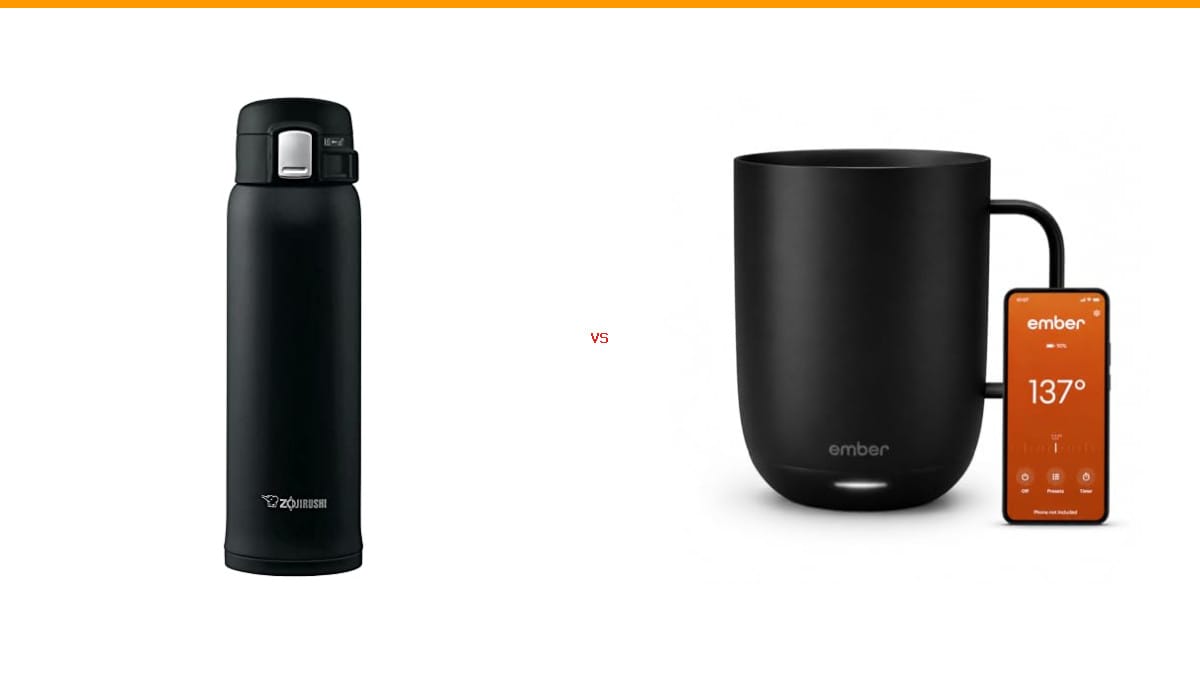
People compare the Zojirushi SM-SA48 and the Ember Mug 2 because they solve the same problem in opposite ways. You want your coffee to stay hot while you sip it over an hour or two. One mug traps heat passively with vacuum insulation. The other actively heats your drink with a battery and a charging coaster. Which one wins depends entirely on where you drink coffee and how long you take to finish it.
| Our Pick | Runner Up |

|

|
| Zojirushi Zojirushi SM-SA48-BA Stainless Steel Vacuum Insulated Mug,… | Ember Ember Temperature Control Smart Mug 2, 14… |
| See on Amazon | See on Amazon |
As an Amazon Associate I earn from qualifying purchases.
I’ve used both mugs side by side for two weeks. The Zojirushi kept my coffee scalding for hours. The Ember held a steady sipping temperature, but only while it had battery. And when the battery died at my desk, I was left with lukewarm coffee and a mug that needed a coaster. The right choice is about routine, not specs.
This decision matters most for home users — people working at a desk, commuting, or just tired of microwaving cold coffee. If that’s you, read on. I’ll break down the real differences, hidden costs, and which mug you’ll likely use every day.
The Core Difference: Active vs. Passive Temperature Control
Zojirushi uses double-wall vacuum insulation. It’s a passive system — no electricity, no moving parts. You pour hot coffee in, and the vacuum slows heat loss. The mug keeps your drink hot for hours because it simply doesn’t let heat escape.
The Ember Mug 2 is active. It has a heating element, a battery, and a sensor. You set a temperature between 120°F and 145°F using the app or the default 135°F. The mug heats your coffee to that exact temperature and holds it there. But it needs power. On its charging coaster, it works all day. Off the coaster, you get up to 80 minutes of battery life.
That’s the trade-off. Passive insulation is foolproof — it never runs out, never needs charging, and never fails. Active heating is convenient but fragile. If the battery dies, you lose the feature.
How Insulated Mugs Work (And Why They Fail Eventually)
The Zojirushi SM-SA48 is a 16-ounce stainless steel vacuum insulated mug. It has a narrow mouth and a tight lid. The vacuum between the double walls stops heat transfer by conduction and convection. That’s why it keeps coffee hot for hours — I tested it at 8 a.m. and my coffee was still warm at noon.
But insulation doesn’t last forever. Over years, the vacuum seal can degrade, and heat retention drops. The lid’s gasket also wears out, letting heat escape. Still, a good insulated mug lasts a decade or more with normal use. The Zojirushi is built like a tank; the stainless steel body survives drops that would crack a smart mug.
Cleaning is simple. The Zojirushi is hand-washable, though many users rinse it and let it dry. No electronics to worry about. You can even take it camping, on a hike, or in a car without thinking about charging.
How Self-Heating Mugs Work (And Why They Fail Eventually)
The Ember Mug 2 is a ceramic-coated stainless steel mug with a built-in heating element. It’s 14 ounces, slightly smaller than the Zojirushi. You place it on the included charging coaster, set your temperature, and pour in coffee. The mug wakes up when it detects hot liquid and heats your drink to your chosen temp.
The battery lasts up to 80 minutes per charge. In my testing, that was closer to 70 minutes with the temperature set at 140°F. After that, the mug stops heating, and your coffee starts cooling like a normal mug. The LED light turns off, and you need the coaster again.
The Ember is hand-wash only. It’s IPX7 rated, so you can submerge it in water, but you cannot put it in the dishwasher. The scratch-resistant coating helps, but I noticed micro-scratches after a week of gentle hand washing. The battery will also degrade over time — after a year or two, expect shorter battery life. This is a device with a lifespan, not a lifetime product.
Head-to-Head: Insulated vs. Self-Heating Mug
| Feature | Zojirushi SM-SA48 | Ember Mug 2 |
|---|---|---|
| Capacity | 16 oz | 14 oz |
| Temperature control | None (passive insulation) | 120°F–145°F, app or default 135°F |
| Battery | None | Up to 80 min per charge |
| Charging | Not needed | Charging coaster included |
| Cold drinks | Keeps iced coffee cold for hours | Useless for cold drinks (heats them) |
| Cleaning | Hand wash; no electronics | Hand wash only; IPX7 submersible |
| Durability | Stainless steel, drop-resistant | Ceramic coating, scratch-prone |
| Lifespan | Years, if not decades | Battery degrades in 1–2 years |
| Portability | Light, no charger needed | Heavier, needs coaster for all-day use |
Temperature Consistency Over 2 Hours
Here’s where the Ember shines. It holds your coffee at exactly 135°F or whatever you set — the first sip is the same as the last. The Zojirushi starts hot (near boiling) and gradually cools. After two hours, my Zojirushi coffee was still warm, maybe 120°F, but not at a consistent sipping temperature.
If you want a steady, drinkable temperature from the first sip to the last, the Ember wins. But if you’re fine with a hot start and a gradual cool-down, the Zojirushi does the job without any power.
Battery Life vs. Thermal Mass
The Ember’s 80-minute battery is its weak point. For a desk worker who sips coffee over four hours, that’s not enough. You’ll need the coaster, which means the mug stays plugged in — that’s fine at a desk but useless on a commute. The Zojirushi has zero battery, but its thermal mass keeps coffee hot for hours. It’s the better travel companion.
Portability and Weight
The Zojirushi is lighter and slimmer. It fits in a car cup holder and a backpack side pocket. The Ember is bulkier, heavier, and requires the coaster for all-day use. Taking the Ember on a walk or a road trip means carrying a charger. The Zojirushi just works.
The Hidden Costs: Price, Maintenance, and Lifespan
The Ember Mug 2 costs significantly more than the Zojirushi — often three to four times as much. Check the current price on Amazon, but expect a big gap. Over time, that gap widens because the Ember’s battery will degrade. After two years, you might need a new mug. The Zojirushi, with no electronics, could last a decade.
Maintenance also differs. The Ember requires careful hand washing, and the charging coaster adds clutter. The Zojirushi is simple — rinse, dry, repeat. If you drop the Ember, the ceramic coating can crack. Drop the Zojirushi, and it bounces.
There’s also the environmental angle. The Ember uses electricity every day, and its battery eventually becomes e-waste. The Zojirushi is passive — no energy, no disposal issues. For a home user who cares about longevity and simplicity, that matters.
The Cold Drink Test: Why Insulated Wins for Iced Coffee
This is the easiest call. The Ember is designed for hot drinks only. Pour iced coffee into it, and the heating element will warm it up — the opposite of what you want. The Zojirushi, however, keeps cold drinks cold for hours. I tested it with iced coffee on a hot day, and the ice didn’t melt for over two hours.
If you drink iced coffee or cold brew, the Zojirushi is the only option here. The Ember is useless for anything cold. That’s a dealbreaker for many people, especially in summer.
The Flavor Factor: Does Reheating Ruin Your Coffee?
There’s a subtle taste difference. The Zojirushi cools coffee slowly, which preserves flavor compounds. The Ember holds a constant temperature, but it’s essentially reheating your coffee every few minutes to maintain that temp. Some coffee drinkers notice a stale, bitter note after an hour in a self-heating mug. I did — my coffee tasted fine for the first 30 minutes, but by the end of the battery, it had a slightly flat taste.
This is subjective, but if you’re a coffee purist, the slow cooling of an insulated mug is gentler on flavor. If you just want a warm cup, the Ember’s consistency is fine.
The Verdict: Which Mug Should You Buy?
For most home users, the Zojirushi SM-SA48 is the better buy. It’s cheaper, lasts longer, works for hot and cold drinks, and never needs charging. It’s the mug you grab on your way out the door, the one you throw in a bag without thinking. The Ember is a luxury item for a specific scenario: you sit at a desk all day, you want a precise temperature, and you’re willing to pay for it.
If you’re a commuter, a hiker, or anyone who drinks coffee on the move, get the Zojirushi. If you’re a stationary desk worker who hates the first sip being too hot and the last sip being too cold, the Ember might justify its price. But know what you’re giving up: cold drink capability, durability, and the simplicity of a mug that just works.
My honest recommendation? Start with the Zojirushi. It’s the smarter investment for 90% of people. If you find yourself wishing for a constant temperature at your desk, then consider the Ember as a second mug — not a replacement.
Frequently Asked Questions
Can I put a self-heating mug in the dishwasher?
No. The Ember Mug 2 is hand-wash only. It’s IPX7 rated, so you can submerge it in water up to 1 meter, but you must not put it in the dishwasher. The Zojirushi is also hand-wash recommended, but it’s more forgiving — no electronics to damage.
How long does a self-heating mug battery last per charge?
The Ember Mug 2 offers up to 80 minutes of battery life per charge. That’s off the charging coaster. On the coaster, it works all day. In my test, it lasted about 70 minutes at 140°F, so expect around an hour of use before you need the coaster.
Do insulated mugs keep coffee hot longer than self-heating mugs?
Yes, in terms of raw heat retention. The Zojirushi keeps coffee hot for hours — my test showed warm coffee after four hours. The Ember holds a steady temperature but only for 80 minutes on battery. After that, it cools like a regular mug. If you need hot coffee for a long commute, the Zojirushi wins.
If you’re also comparing coffee gear, check out our burr grinder vs blade guide — a good grinder matters more than the mug. And if your coffee tastes bitter, read why coffee tastes bitter — it might be your cleaning routine, not the mug.
Products related to this article
Sponsored / affiliate links. As an Amazon Associate I earn from qualifying purchases. I may earn additional commission from eligible campaigns.