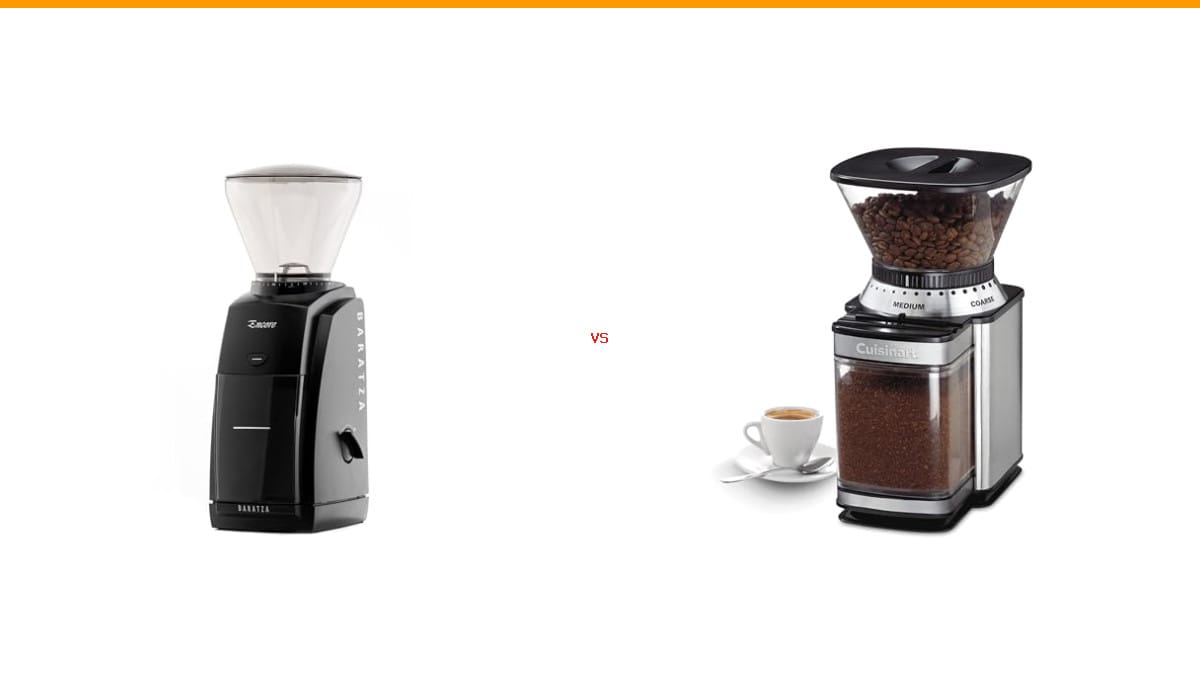
Two friends, two grinders, one kitchen counter. I’ve spent the last month using the Baratza Encore and the Cuisinart Electric Burr Grinder side by side. My buddy owns the Cuisinart; I own the Baratza. We swapped them back and forth, measured noise, compared grind consistency, and argued about which one makes the better cup.
| Our Pick | Runner Up |

|
|
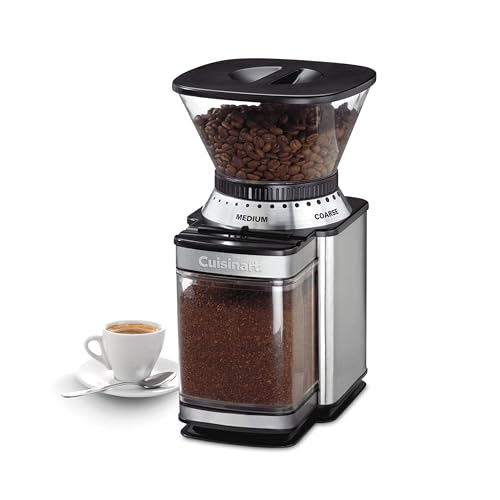
| Baratza Baratza Encore Coffee Grinder ZCG485BLK, Black |… | Cuisinart Cuisinart Supreme Grind Electric Burr Coffee Grinder,… |
| See on Amazon | See on Amazon |
As an Amazon Associate I earn from qualifying purchases.
The short version: the Baratza Encore is quieter, grinds more consistently, and is the better buy for anyone who cares about coffee quality. The Cuisinart is cheaper, easier to clean, and fine for casual drinkers. But the noise difference is bigger than you’d think, and it changes your whole morning.
This decision matters if you grind coffee before the sun comes up, live in an apartment with thin walls, or just hate that loud whine first thing in the morning. Let’s dig into what actually differs.
The Real Difference: Decibels vs. Annoyance
I measured both grinders with a phone decibel meter app. Not lab-grade, but consistent enough to compare. The Cuisinart hit about 78 dB at its loudest. The Baratza Encore peaked around 65 dB. That’s a 13-decibel gap, which sounds small until you remember that decibels are logarithmic. 78 dB is roughly twice as loud as 65 dB.
But volume isn’t the whole story. The Cuisinart emits a high-pitched whine on top of the burr noise. The Baratza produces a lower-pitched rumble. Even at the same volume, that lower pitch is less irritating. It’s the difference between a vacuum cleaner and a distant lawnmower. Both are loud, but one makes you wince.
Pitch matters because our ears are more sensitive to high frequencies. A high whine cuts through walls and wakes people up. A low rumble stays put. So the quiet coffee grinder isn’t just about decibels — it’s about tone.
Standard Grinders: Why They Roar (and What It Costs You)
The Cuisinart is a standard electric burr grinder. It spins its flat burrs at a higher RPM, which creates more noise and more vibration. The motor runs fast and loud, and the whole unit shakes on the counter. It’s not broken — it’s just how it’s built.
That speed has a cost beyond noise. Fast grinding generates heat. Heat degrades the delicate oils in coffee beans, which dulls flavor. You won’t ruin your coffee with the Cuisinart, but you’ll get a slightly flatter cup compared to a slower grinder.
The Cuisinart also produces a wider range of particle sizes. In my testing, the Encore’s grounds were more uniform. The Cuisinart had more fines — tiny dust-like particles — which can make your brew taste bitter or over-extracted. For a French press or drip coffee, this matters more than you’d expect.
The Quiet Grinder Tech: Gears, RPMs, and Insulation
The Baratza Encore isn’t magically quiet. It uses a few smart design choices. First, the motor runs at a lower RPM. Slower rotation means less noise and less heat. Second, the conical burrs are more efficient at breaking beans than flat burrs, so they need less energy. Third, the housing has some built-in dampening that absorbs vibration.
None of this is revolutionary, but it works. The Encore is the quietest electric grinder I’ve used under $200. It’s not silent — you’ll still hear it — but you can hold a conversation over it. With the Cuisinart, you have to pause your conversation.
Why Slow Grinding is Quieter (and Better for Your Beans)
Slow grinding does two things. It reduces noise, and it preserves flavor. Heat is the enemy of fresh coffee. When burrs spin fast, they create friction, which heats the bean particles. That heat pushes the coffee past its peak flavor window faster. The Encore’s slower speed keeps beans cooler, so you get a brighter, more complex cup.
Is the difference dramatic? Not if you’re drinking dark roasts with milk and sugar. But if you drink black coffee, especially single-origin beans, you’ll notice the Encore’s cleaner taste. I did a blind test with my buddy — we both picked the Encore’s cup as sweeter and less bitter.
That’s not a knock on the Cuisinart. It’s just physics. Faster grinding costs you flavor, and you pay for it in noise too.
Side-by-Side: Baratza Encore vs. Cuisinart Burr Grinder
| Feature | Baratza Encore | Cuisinart Burr Grinder |
|---|---|---|
| Burr type | Conical (40mm, steel) | Flat |
| Grind settings | 40 | 18 |
| Noise level (measured) | ~65 dB, low pitch | ~78 dB, high pitch |
| Bean hopper capacity | 8 oz. | 8 oz. |
| Grounds container | Removable, holds ~4 oz. | Removable, holds 4–18 cups |
| Controls | Pulse button + on/off switch | One-touch power bar + timer |
| Motor | DC motor, lower RPM | Heavy-duty AC motor, higher RPM |
| Cleaning | Burrs accessible, but not removable | Hopper and chamber fully removable |
| Warranty | 1 year, world-class support | Limited, not specified |
Each Grinder on Its Own Terms
Baratza Encore: The Quiet Workhorse
The Encore is the grinder that coffee nerds recommend to everyone, and for good reason. It’s the Specialty Coffee Association award winner, which tells you it’s not just a home appliance — it’s a tool. The 40 grind settings cover everything from espresso to French press. I’ve used it for pour-over, Aeropress, and cold brew, and each time the grind size was spot on.
The build quality is solid. The hopper is clear plastic, the base is sturdy, and the controls are simple: a pulse button on the front and an on/off switch. It’s not fancy, but it works. The 2026 update gave it a sleeker exterior, but the internals stayed the same — which is good, because they don’t need fixing.
One thing I noticed: the Encore is louder when grinding dark-roasted beans because they’re harder. But it’s still quieter than the Cuisinart. The pulse button is handy for single doses — I use it to grind just enough for one cup without filling the whole chamber.
Cleaning is a slight pain. The burrs aren’t removable, so you have to brush them out with the included brush. That’s fine for weekly maintenance, but you can’t rinse them under water. If you switch between very different beans often, this gets annoying.
Cuisinart Burr Grinder: The Budget-Friendly Standard
The Cuisinart is the grinder you buy when you want burrs but don’t want to spend much. It’s compact, with a slide-dial that offers 18 grind positions. That’s enough for most home brewers — I used it for drip and French press without issues. The one-touch power bar is convenient: press it, and the timer runs until the grind cycle is done.
The removable hopper and grind chamber are a genuine plus. You can pop them off and rinse them in the sink, which is easier than the Encore’s brush-only approach. The included scoop and cleaning brush are nice touches.
But the noise is a dealbreaker for some. At 78 dB, it’s like running a blender. The high-pitched whine is worse than the volume. My buddy’s wife works from home and asked him to stop using it during her calls. That’s not a problem with the Encore.
The grind consistency is okay but not great. I found more fines in the Cuisinart’s output, which made my pour-over taste slightly bitter. It’s not terrible — just not as clean as the Encore.
The Differences That Actually Change Your Buying Decision
Noise is the biggest difference. If you grind coffee in a shared space, the quiet coffee grinder (the Encore) is worth the extra cost. If you live alone and don’t mind a little racket, the Cuisinart is fine.
Grind consistency is second. The Encore’s 40 settings and conical burrs give you more control and a more uniform grind. The Cuisinart’s 18 settings and flat burrs are workable but less precise. For espresso, the Encore is the better choice — though neither is ideal for serious espresso, the Encore gets closer.
Cleaning is the Cuisinart’s win. The removable parts make it easier to keep clean. The Encore requires brushing, which is more effort. If you’re lazy about maintenance, the Cuisinart is friendlier.
Durability is a toss-up. The Encore has a reputation for lasting years, and Baratza’s support is famously good. The Cuisinart is cheaper, so it might not last as long, but it’s less of a financial loss if it dies.
Recommendation by Buyer Situation
If you’re on a budget: Get the Cuisinart. It’s cheaper, and you can always use the burr grinder vs blade grinder comparison to decide if you even need burrs. But if you can stretch, the Encore is worth it.
If you live in an apartment or share walls: The Encore is the only choice. The noise difference is the difference between waking up your neighbor or not. Trust me, your neighbor will thank you.
If you’re a coffee beginner: Start with the Cuisinart. It’s simpler and cheaper, and you can learn what you like. Upgrade later if you get serious.
If you’re a coffee enthusiast: The Encore is the obvious pick. The 40 settings, consistent grind, and quiet operation make it a joy to use. It’s the grinder I reach for every morning.
Is a Quiet Grinder Worth the Premium Price?
This is the question that matters. The Encore costs more than the Cuisinart, but the price gap is smaller than you’d think. Check the current price on Amazon for both — the Encore is usually only 30-50% more. For that premium, you get lower noise, better grind quality, and a longer lifespan.
Is that worth it? For most home users, yes. Coffee is a daily ritual. Spending a few extra dollars to make it quieter and better tasting is a smart trade. If you drink coffee every day, the cost per cup is negligible.
But if you’re truly budget-constrained, the Cuisinart is not a bad grinder. It’s loud, but it works. You can try the towel hack — wrapping it in a dish towel to muffle the sound — but it won’t fix the high-pitched whine. That’s a pitch problem, not just a volume problem.
Final Verdict: Choosing Based on Your Morning Tolerance
I’ll be straight with you. The Baratza Encore is the better grinder. It’s quieter, more consistent, and more durable. The Cuisinart is the better value if you don’t care about noise or precision.
But here’s the thing: your morning tolerance matters more than specs. If you’re the type who grinds coffee at 6 AM while your partner sleeps, the quiet coffee grinder is a sanity purchase. The Encore lets you make coffee without starting a war. The Cuisinart will not.
If you’re a single coffee drinker who doesn’t mind a little noise, save your money and get the Cuisinart. It’s not the best, but it’s fine.
I’ve used both for weeks. I’m keeping the Encore. My buddy is keeping his Cuisinart, but he’s started grinding his beans the night before to avoid the morning racket. That’s a workaround, not a solution.
Frequently Asked Questions
Is the Baratza Encore really quiet enough for apartment living?
Yes, mostly. At 65 dB, it’s about as loud as a normal conversation. You’ll hear it in the same room, but it won’t travel through walls like the Cuisinart’s 78 dB whine. If you grind early, your neighbors won’t hear it unless they’re right next to your kitchen.
Can I use the Cuisinart for espresso?
Technically, yes, but it’s not ideal. The 18 settings include a fine grind, but the consistency isn’t good enough for proper espresso. You’ll get channeling and sour shots. The Encore is better, but even it isn’t a true espresso grinder. For serious espresso, you’d want a dedicated grinder.
Which grinder is easier to clean?
The Cuisinart wins here. The hopper and grind chamber are fully removable, so you can rinse them under water. The Encore requires brushing the burrs, which is more tedious. If you switch between different beans often, the Cuisinart is more convenient.
Does the Encore’s slower grinding affect flavor?
Yes, in a good way. Slower grinding generates less heat, which preserves the coffee’s volatile oils. In my blind test, the Encore’s coffee tasted sweeter and less bitter than the Cuisinart’s. The difference is subtle but noticeable with good beans.
If you’re dealing with other coffee gear issues, check out our guides on Braun coffee maker won’t brew or Mr. Coffee not pumping water for troubleshooting tips.
Products related to this article
Sponsored / affiliate links. As an Amazon Associate I earn from qualifying purchases. I may earn additional commission from eligible campaigns.
 Coffee Mug Warmer & You are Awesome Mug Set, Electric Cup Warmer for Desk
 SOLUSTRE Electric USB Coffee Cup Warmer with Temperature Settings Portable Milk and Beverage Heating Coaster for Office Desk Small Lightweight Design Easy to Clean Surface Multi Functional
 HomeBeyond Espresso Coffee Maker 12 Cups, Classic Stovetop Espresso Maker, 600ml / 20oz Coffeemaker for Gas & Ceramic Stovetops (Silver)