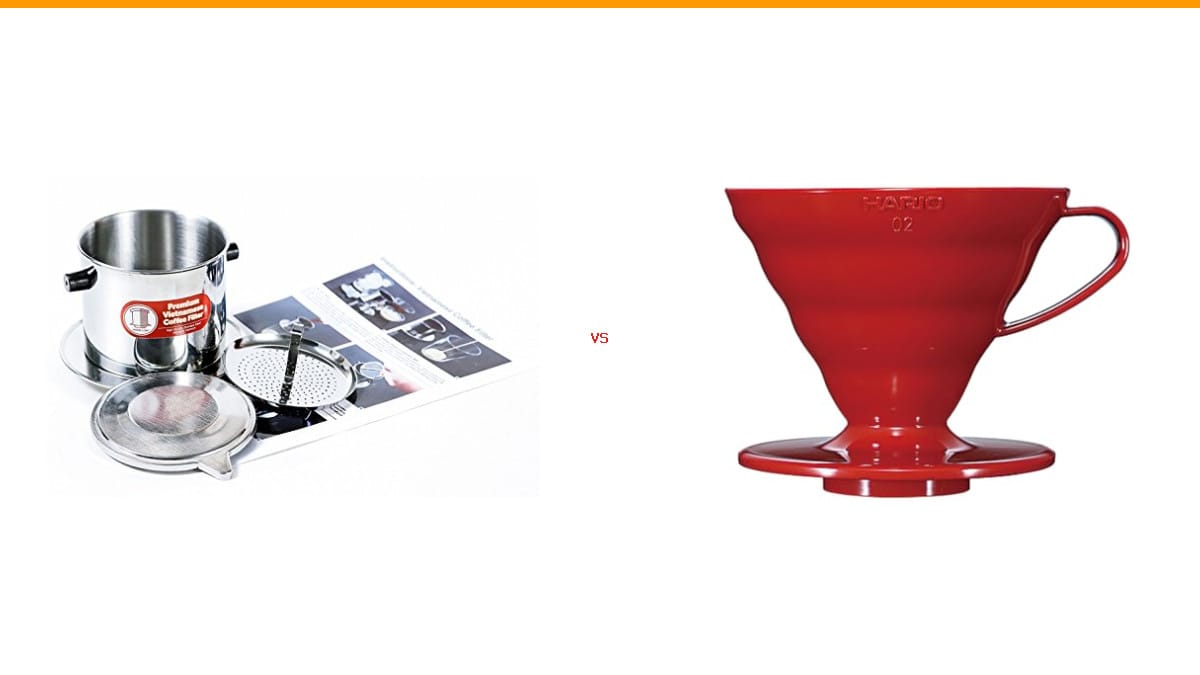
You’ve seen both on Instagram: the slow drip of a Vietnamese phin filter over a glass of condensed milk, and the precise spiral pour of a Hario V60. Both make a single cup of coffee. Both look beautiful on a counter. But they brew completely different drinks, and they ask completely different things from you.
| Our Pick | Runner Up |

|

|
| Thang Long Vietnamese Coffee Filter Phin 11 Ounce (Large),… | HARIO Hario V60 Plastic Coffee Dripper, Size 02,… |
| See on Amazon | See on Amazon |
As an Amazon Associate I earn from qualifying purchases.
I’ve spent weeks using the Thang Long Vietnamese Coffee Filter and the Hario V60 Plastic Dripper side by side. I brewed the same beans through both, timed every drip, and cleaned up after every mess. The short version: the phin is for people who want a bold, syrupy, forgiving cup with zero fuss. The V60 is for people who want a bright, clean, tea-like cup and don’t mind a little ritual. Neither is wrong. But one will fit your morning better than the other.
This comparison is for the home brewer who wants one reliable method. You’re not running a café. You just want good coffee without a machine the size of a toaster. Let’s settle it.
The Brewing Ritual: Phin vs. Pour-Over Mechanics
These two devices look similar — a cone over a cup — but they work on opposite principles.
The Thang Long phin is a gravity-fed immersion brewer. You add coffee grounds, press the gravity insert down, pour hot water over it, and let it drip. No pouring technique. No gooseneck kettle. No bloom. You walk away and come back in five minutes.
The Hario V60 is a pure pour-over cone. The spiral ridges and single large hole mean the water flows through fast. You control the flavor by how you pour — quick for a lighter body, slow for a richer extraction. It rewards attention and punishes neglect.
Here’s the immediate difference: the phin brews itself. The V60 brews because you brew it. If you’re half-asleep at 6 AM, the phin wins. If you enjoy the act of making coffee, the V60 wins.
Step-by-Step Side-by-Side
I brewed both with the same medium roast, ground to the right size for each method.
- Thang Long phin: 15 grams of coffee, 90 ml of hot water to bloom for 30 seconds, then 150 ml more. Total brew time: 4 minutes 40 seconds. The drip was steady, never clogged, and the gravity insert sat flush without needing to be screwed down.
- Hario V60: 15 grams of coffee, 45 ml of water to bloom for 45 seconds, then pour in slow circles up to 240 ml. Total brew time: 2 minutes 50 seconds. The spiral ridges kept the bed flat, and the single hole gave a clean, even flow.
The phin took almost twice as long. But it required zero attention. The V60 needed my full focus for three minutes. That’s the trade-off.
| Feature | Thang Long Phin | Hario V60 |
|---|---|---|
| Brewing method | Gravity drip (immersion) | Pour over (percolation) |
| Brewing time (15g coffee) | ~5 minutes | ~3 minutes |
| Filter type | Reusable stainless steel mesh | Paper filter (V60 size 02) |
| Skill required | Minimal — set and forget | Moderate — pour control matters |
| Body | Heavy, syrupy, oily | Light, clean, tea-like |
| Best with | Sweetened condensed milk, ice | Black, or with a splash of milk |
| Durability | Stainless steel — nearly indestructible | Plastic — light but scratches |
| Cleanup | Rinse and wipe | Throw away paper filter, rinse cone |
Flavor and Mouthfeel: Bold & Syrupy vs. Bright & Tea-Like
The biggest difference is in the cup. I brewed the same beans through both, and the two drinks tasted like they came from different planets.
The phin produced a dark, heavy coffee with a thick mouthfeel. The metal filter let fine particles and natural oils through, which gave it a rich, almost espresso-like body. It wasn’t bitter, but it was intense. When I added sweetened condensed milk and poured it over ice, it became exactly what you’d get at a Vietnamese café — sweet, creamy, and dangerously drinkable.
The V60 gave a completely different cup. The paper filter stripped out the oils and sediment, leaving a bright, floral, tea-like brew. The same beans tasted fruitier and more complex. It was clean and crisp, but it felt thin next to the phin. I wouldn’t add condensed milk to it — that would mask the delicate flavors.
If you drink coffee black and want to taste the origin of the beans, the V60 is the better choice. If you want a bold, comforting cup that stands up to milk and sugar, the phin wins.
The Role of the Filter (Metal Mesh vs. Paper)
The filter is the heart of each brewer.
The phin’s stainless steel mesh is reusable. It lets oils and fine grounds into your cup, which creates the heavy body and rich flavor. It also means you’ll get a little silt at the bottom of your cup — that’s normal and part of the experience. Cleanup is a quick rinse under the tap.
The V60 uses a paper filter (size 02). Paper catches everything, so your cup is crystal clear. It also absorbs some of the coffee oils, which is why the flavor is cleaner but less rich. Cleanup means throwing away the wet filter and rinsing the cone. It’s easy, but you’re buying filters forever.
For the environment, the phin’s reusable mesh is the clear winner. No paper waste, and stainless steel lasts decades. The V60’s paper filters are compostable, but they still end up in the trash in most homes.
Time, Effort, and Cleanup: Which Fits Your Morning?
Let’s talk about the real-world experience, not just the specs.
The Thang Long phin is the most forgiving brewer I own. You don’t need a scale or a gooseneck kettle. You can eyeball the water, and it still tastes good. The gravity insert means you don’t have to screw anything down — just drop it in and pour. It’s also built like a tank. Stainless steel, no glass to break, dishwasher safe. I’ve dropped mine twice and it’s fine.
The Hario V60 is more demanding. You need a gooseneck kettle to pour slowly, a scale to measure water, and a timer to track your bloom. If you pour too fast, you get a weak, sour cup. If you pour too slow, it over-extracts and tastes bitter. It took me about a week to get consistent results. But once I did, the control was addictive. I could adjust the pour to highlight different flavor notes.
Cleanup is a wash. The phin needs a rinse and a wipe to get the grounds out. The V60 needs the paper filter tossed and the cone rinsed. Both are quick. The phin might leave a little oil residue that needs a soapy wash every few days.
One honest caveat: the phin’s metal filter means your cup will have fine grounds in the bottom. If that bothers you, the V60’s paper filter is cleaner. But if you like a rustic, full-bodied cup, you won’t mind.
The Verdict: Choosing Based on Your Coffee Personality
So which should you buy? It comes down to your coffee personality.
Choose the Thang Long phin if:
- You want a bold, strong cup that stands up to milk and sugar.
- You don’t want to buy paper filters or learn pour-over technique.
- You like the idea of a nearly indestructible stainless steel brewer that lasts forever.
- You’re on a budget — the phin is typically much cheaper than a V60 setup (check current prices on Amazon).
- You want to make Vietnamese iced coffee (cà phê sữa đá) at home.
Choose the Hario V60 if:
- You drink coffee black and want to taste the origin of the beans.
- You enjoy the ritual of pouring and controlling the brew.
- You already have a gooseneck kettle and a scale, or you’re willing to buy them.
- You want a clean, sediment-free cup with a tea-like body.
- You like experimenting with grind size and pour speed.
For most home users, I’d say the phin is the smarter buy. It’s cheaper, more durable, and easier to use. You can make a great cup of coffee with nothing but the filter, ground coffee, and hot water. The V60 is a better tool for a coffee enthusiast who wants control, but it demands more equipment and practice.
That said, I reach for the V60 more often on weekends when I have time to savor the process. The phin is my weekday workhorse. If you can afford both, get both. If not, start with the phin — it’s the friendlier introduction to manual brewing.
If you’re dealing with a coffee maker that won’t brew at all, a manual filter like these can be a lifesaver. Check out our guide on common coffee maker issues if your machine is acting up.
Frequently Asked Questions
Which method has more caffeine?
The phin typically produces a stronger, more concentrated cup. Because the metal filter lets more coffee oils and fine particles through, and the brew ratio is often higher (more coffee per water), the phin’s cup has a heavier body and a stronger caffeine kick per ounce. The V60’s paper filter removes some oils, and the brew ratio is usually lighter, so the cup is less intense. If you’re sensitive to caffeine, start with the V60.
Can I use the same grind size for both?
No. The phin needs a coarse to medium-coarse grind — like sea salt. The V60 needs a medium-fine grind — like table salt. If you use a fine grind in the phin, it will clog and drip too slowly. If you use a coarse grind in the V60, the water will rush through and under-extract. Grind size is the most important variable for both.
Can I make iced coffee with the V60?
Yes, but it’s not the same. For a V60 iced coffee, brew a double-strength batch directly over ice. It will dilute as the ice melts, so you need a stronger ratio. The phin is better for iced coffee because the condensed milk and ice are part of the traditional recipe, and the bold flavor holds up better.
How do I clean the Thang Long phin properly?
Rinse it under hot water immediately after use to remove grounds. Use a soft brush to clean the mesh if needed. It’s dishwasher safe, but hand washing keeps the mesh clear of oils. Avoid soap on the mesh — it can leave a residue that affects flavor. If you notice a dull drip, soak it in hot water with a little baking soda to clear the pores.
For more on keeping your brewing gear clean, see our guide on how often to clean your coffee maker.
And if you’re curious about why regular cleaning matters for flavor, read this article.
Products related to this article
Sponsored / affiliate links. As an Amazon Associate I earn from qualifying purchases. I may earn additional commission from eligible campaigns.
 Stainless Steel Moka Pot Coffee Filter Disc for Espresso Brewing, Coffee Maker Replacement Filter Plate for Home Office Coffee Bar Cafe (FOR 4 Cups)
 Stainless Steel Moka Pot Pressed Powder Tool for 2 4 6 9 Cup Espresso Coffee Brewer(6 Cups)
 Long Handle Wooden Spoon For Mixing Coffee Tea Jam and Bath Salt In Kitchen, Environmentally Friendly Table Spoon, 8.6 Inches,4 Pieces…