You notice your morning brew tastes a bit off. The brew time stretches longer than it used to. Maybe you see white flakes floating in your cup. That’s limescale — the hard water mineral buildup that silently degrades your coffee machine’s performance and your coffee’s flavor.
When it’s time to descale, most people reach for one of two options: a commercial descaler or plain white vinegar. Both work, but they’re not equal. Vinegar is cheap and available. Commercial descalers are formulated for the job but cost more. This article breaks down the real differences — effectiveness, cost, safety, smell, and what each does to your machine’s internal parts — so you can pick the right one and descale properly.

IMPRESA
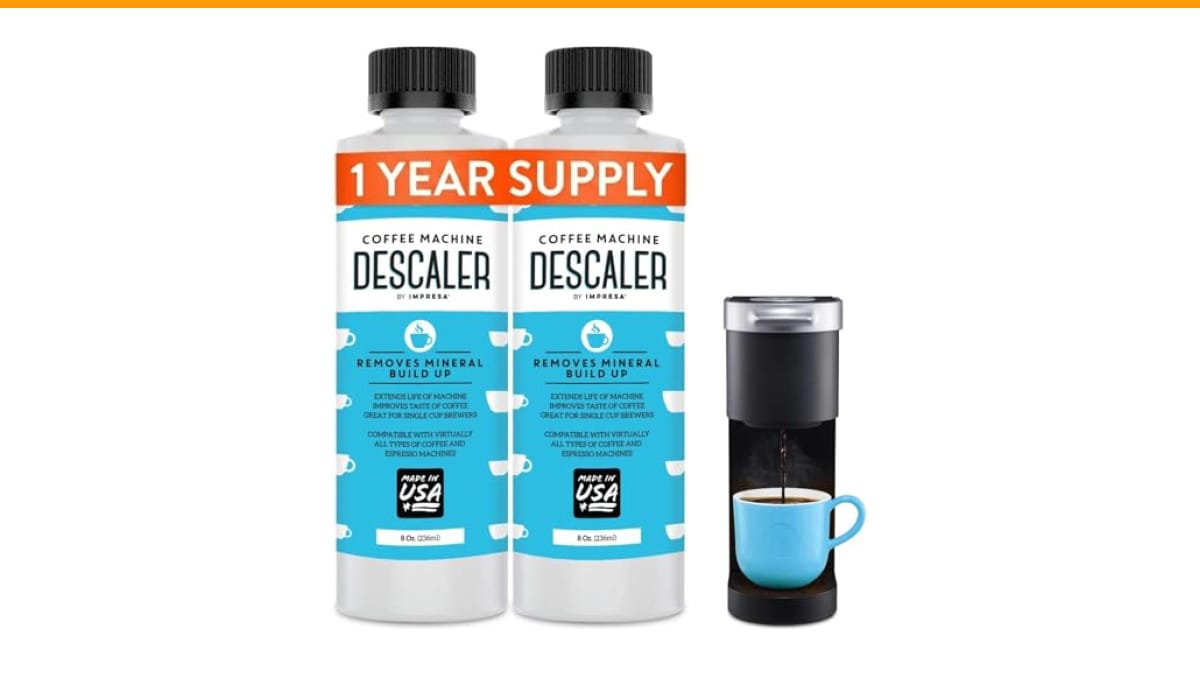
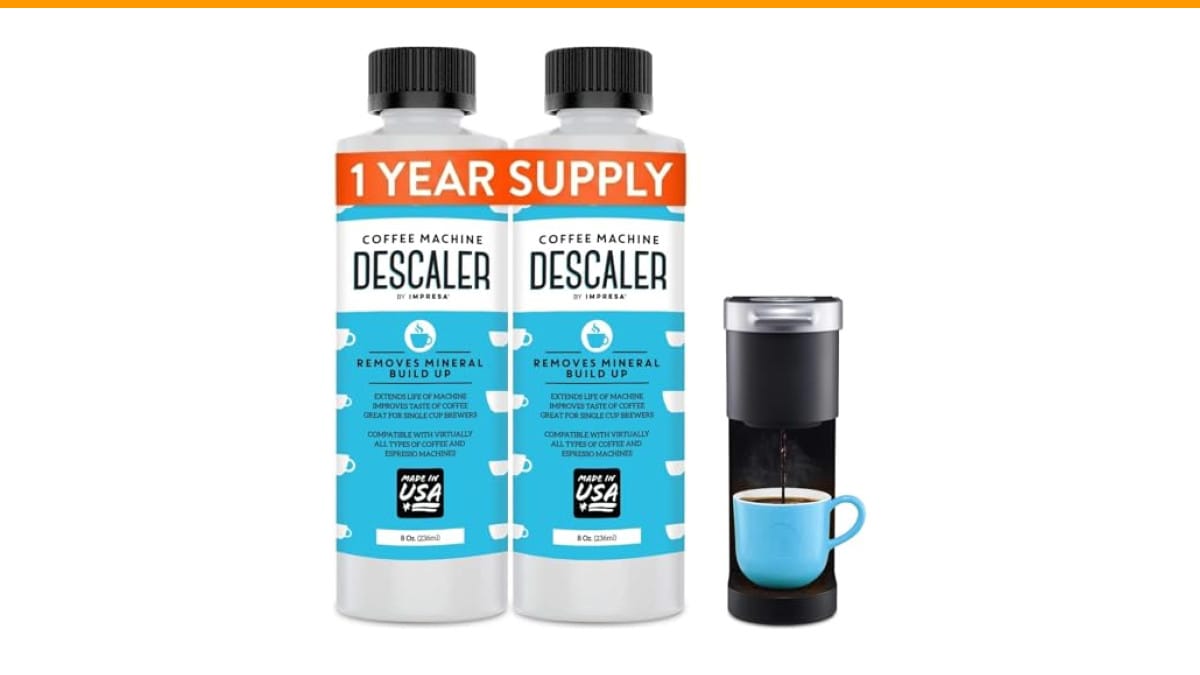
IMPRESA Coffee Machine Descaler, 2-Pack (1-Year Supply)…
- 2-Pack Coffee Descaler and Cleaner - Clean and rinse away residue and oil buildup in your coffee maker with Impresa's Coffee Desca…
- Highly Effective, Made in USA Formula - Unlike most common solutions, our coffee machine cleaner uses just 4 ounces (1/2 bottle) p…
- Preserves Your Machine - Using a coffee descaling solution eliminates limescale and mineral build-up to prevent corrosion, signifi…
As an Amazon Associate I earn from qualifying purchases.
By the end, you’ll know exactly how to descale a drip or single-serve machine, how to neutralize acid after descaling (the step most people skip), and how often to do it based on your water hardness.
If you’re in a hurry and want a reliable, no-fuss option, the IMPRESA Coffee Machine Descaler is a solid choice. It’s a two-pack of 8-ounce bottles, each good for two descaling sessions. That’s four cleanings per pack, or about a year’s supply if you descale every three months. It works with Keurig, Breville, Nespresso, and most other machines.
Why Descaling Matters (And What Happens If You Skip It)
Every time you brew, water flows through your machine’s internal tubing, boiler, and heating element. If your tap water has any hardness at all — and most does — it leaves behind calcium and magnesium deposits. Over time, those deposits build up into a crusty layer of limescale.
That scale acts as an insulator. It makes your machine work harder to heat water, which means longer brew times and higher energy use. It can clog the tiny needles in single-serve machines like Keurig, causing weak or sputtering brews. And it provides a hiding place for bacteria and mold, which can affect the taste and safety of your coffee.
Ignoring scale buildup is the fastest way to shorten your machine’s lifespan. A $20 bottle of descaler is a lot cheaper than a $200 replacement. Even if you use filtered water, some minerals still get through. Regular descaling is the only way to keep the internals clean.
The Contenders: Commercial Descaler vs. Vinegar – A Quick Overview
Commercial descalers are acid-based solutions designed specifically for coffee machines. The active ingredient is usually citric acid, sulfamic acid, or lactic acid. They’re formulated to dissolve limescale quickly without damaging the metals, plastics, and rubber seals inside your machine. They also often contain anti-corrosion agents and surfactants that help rinse away residue.
Vinegar is a 5% acetic acid solution. It’s a natural descaler that’s been used in home kitchens for generations. It’s cheap, non-toxic, and readily available. But it’s not formulated for coffee machines. The acid concentration and chemical properties are different from commercial descalers, and that matters for your machine’s materials and for the taste of your next brew.
Here’s a quick rundown of the key differences:
- Effectiveness: Commercial descalers dissolve scale faster and more completely. Vinegar works but may require multiple passes for heavy buildup.
- Cost: Vinegar is pennies per use. Commercial descalers cost a few dollars per session but are more concentrated.
- Smell: Vinegar has a strong, lingering odor. Commercial descalers are mostly odorless or have a mild citrus scent.
- Safety: Both are safe when used properly, but vinegar can damage certain materials if left too long or used too often.
- Manufacturer warranty: Most coffee machine warranties explicitly state that using vinegar voids the warranty. Commercial descalers are usually approved or recommended.
Head-to-Head Comparison: Effectiveness, Cost, Speed, and Safety
| Factor | Commercial Descaler | White Vinegar |
|---|---|---|
| Active ingredient | Citric acid, sulfamic acid, or lactic acid | Acetic acid (5%) |
| Effectiveness on heavy scale | High — dissolves scale quickly, often in one cycle | Moderate — may need multiple cycles for thick scale |
| Cost per descale | $2–$5 per session (depends on brand) | ~$0.10–$0.25 per session |
| Time required | 30–45 minutes (including rinse) | 60–90 minutes (including multiple rinses) |
| Smell | Mild or odorless | Strong vinegar smell that lingers |
| Material safety | Formulated for coffee machine parts | Can corrode aluminum, damage rubber seals over time |
| Warranty impact | Usually approved by manufacturers | Often voids warranty |
| Residual taste | Minimal if rinsed properly | Can leave vinegar taste if not thoroughly rinsed |
| Environmental impact | Contains synthetic chemicals; dispose per label | Biodegradable and non-toxic |
Material Compatibility: What Vinegar Can Damage
Vinegar is acidic enough to corrode certain metals. Aluminum is the biggest concern. Many espresso machines and some drip coffee makers have aluminum boilers or heating elements. Acetic acid eats away at aluminum, creating pits and eventually causing leaks. Stainless steel is more resistant, but not immune — prolonged exposure can cause pitting.
Plastic components and rubber seals are also at risk. Vinegar can dry out rubber gaskets, making them brittle and prone to cracking. That leads to leaks and loss of pressure in espresso machines. Commercial descalers are formulated to be safe on these materials, which is why manufacturers recommend them.
If you have a cheap drip machine with no metal boiler, vinegar is less risky. But for any machine with an aluminum boiler or rubber seals — especially espresso machines — stick to a commercial descaler.
The Smell and Taste Factor: How to Eliminate Residual Odor
Vinegar has a strong smell that can linger in the machine’s internal tubing. Even after multiple water-only cycles, you might catch a whiff of vinegar in your next brew. The taste can also carry over, ruining a good cup of coffee.
To get rid of the smell, you need to run several full water cycles — usually 3 to 5 — until the water comes out clear and odor-free. Some people add a slice of lemon or a teaspoon of baking soda to the water to help neutralize the acid, but that can leave its own residue. The simplest method is plain water, run through the machine multiple times.
Commercial descalers don’t have this problem. Most are odorless or have a light citrus scent that rinses out completely with one or two water cycles.
Step-by-Step: How to Descale with a Commercial Solution
- Empty the water reservoir and remove any coffee grounds or used pods.
- Mix the descaler according to the label. For the IMPRESA solution, use 4 ounces (half a bottle) per session, and fill the rest of the reservoir with water.
- Place a large container (at least 12 cups) under the brew head to catch the runoff.
- Start a brew cycle without any coffee. Let the solution run through the machine until the reservoir is empty.
- Turn off the machine and let it sit for 15–30 minutes. This lets the acid work on stubborn scale.
- Discard the wastewater.
- Fill the reservoir with fresh water and run 2–3 full cycles to rinse out any remaining descaler.
That’s it. The whole process takes about 30–45 minutes. Commercial descalers are fast because they’re concentrated.
Step-by-Step: How to Descale with Vinegar (The Safe Way)
- Mix one part white vinegar with one part water. For a standard 12-cup machine, that’s 6 cups of vinegar and 6 cups of water.
- Pour the mixture into the reservoir and start a brew cycle without coffee. Turn the machine off halfway through and let it sit for 30–60 minutes.
- Finish the cycle and discard the vinegar solution.
- Fill the reservoir with fresh water and run at least 3–4 full cycles to rinse. The first one or two will still smell like vinegar — that’s normal.
- If the smell persists, run additional water cycles. Do not brew coffee until the vinegar smell is completely gone.
The key with vinegar is patience. Don’t rush the rinse phase. Skipping a rinse cycle will leave a vinegar taste in your coffee.
The Neutralization Rinse: The Critical Step Everyone Misses
After descaling, your machine’s internals are coated in acidic residue. If you don’t rinse it out completely, that acid will continue to eat away at metals and seals. It also leaves a bitter, chemical taste in your coffee.
The neutralization rinse is a final step that many people skip. It’s simple: after the standard rinse cycles, run one more cycle with a solution of water and a pinch of baking soda. Baking soda is alkaline, so it neutralizes any remaining acid. Then run one more plain water cycle to flush out the baking soda.
This extra step takes five minutes and protects your machine long-term. It’s especially important if you used vinegar, but it’s also good practice with commercial descalers.
Pro tip: If you descale regularly, you can skip the neutralization rinse with most commercial descalers — they’re designed to rinse clean. But it never hurts to do it.
How to Descale Different Machine Types (Drip vs. Single-Serve)
Drip coffee makers are the easiest to descale. You pour the solution into the reservoir, run a brew cycle, let it sit, then rinse. The water flows through the heating element and out the showerhead, so the whole path gets cleaned.
Single-serve machines like Keurig and Nespresso have a more complex path. The water goes through a needle that pierces the pod, and scale can clog that needle. Here’s how to handle it:
- Run the descaling solution through a brew cycle without a pod.
- After the cycle, use a paperclip or a specialized cleaning tool to gently unclog the needle if you notice a weak stream.
- Run at least 3 water-only cycles to rinse. The needle is narrow, so it holds onto residue longer.
For espresso machines with a steam wand, descale the boiler as usual, then purge the steam wand by running steam for a few seconds to clear any scale in the wand.
How Often Should You Descale? (A Simple Chart by Water Hardness)
| Water Hardness | Descaling Frequency | Signs You’re Due |
|---|---|---|
| Soft (0–3 grains per gallon) | Every 6–12 months | Brew time slightly longer |
| Moderate (4–7 gpg) | Every 3–6 months | White flakes in water or coffee |
| Hard (8–10 gpg) | Every 2–3 months | Visible scale on kettle or boiler |
| Very hard (10+ gpg) | Monthly | Slow brewing, sputtering, off taste |
If you’re not sure about your water hardness, check your local water utility report or use a simple test strip. Most coffee machine manuals also have a recommended schedule.
The Verdict: Which Should You Choose?
For most people, a commercial descaler is the better choice. It’s faster, safer for your machine, and doesn’t leave a lingering smell. The IMPRESA descaler we mentioned is a good option — it’s concentrated, so you use less per session, and it’s compatible with a wide range of machines.
Vinegar is fine for a cheap drip machine if you’re on a tight budget and don’t mind the smell. Just be aware of the risks: potential damage to aluminum parts and rubber seals, and the hassle of multiple rinses. If you use vinegar, do it occasionally, not every time.
Here’s my honest take: I’ve used both. Vinegar works in a pinch, but the smell and the extra rinse cycles make it a chore. A commercial descaler is more expensive per use, but it saves time and protects your investment. If your machine cost more than $50, use the commercial stuff.
Frequently Asked Questions
Can you use vinegar to descale a Keurig?
Yes, but Keurig’s official instructions say not to. The company recommends using a commercial descaler because vinegar can damage the internal components over time. If you do use vinegar, dilute it 50/50 with water and rinse thoroughly.
How many times should I rinse after descaling with vinegar?
At least 3–4 full cycles with fresh water. The first one or two will still smell like vinegar. Keep going until the water comes out clear and odor-free. A neutralization rinse with baking soda can speed this up.
Will vinegar void my coffee maker warranty?
Most manufacturers explicitly state that using vinegar voids the warranty. Check your manual. If you’re within the warranty period, use a commercial descaler to be safe.
What is the best descaler for espresso machines?
Look for a descaler that’s compatible with your machine’s material. Most commercial descalers are safe for stainless steel and plastic. Avoid generic descalers that contain hydrochloric acid, which can damage metals. The IMPRESA descaler is a safe bet for most machines.
Can I descale with lemon juice instead of vinegar?
Lemon juice contains citric acid, which is a common descaler ingredient. It works but can leave a sticky residue if not rinsed well. It’s also more expensive than vinegar. If you use lemon juice, strain it first to remove pulp, and rinse thoroughly.
Final Takeaway
- Descale every 3–6 months for most homes, more often if you have hard water.
- Use a commercial descaler for machines with aluminum boilers or rubber seals.
- Vinegar is a budget option for cheap drip machines, but expect extra rinse cycles.
- Always run a neutralization rinse with baking soda after descaling to protect your machine.
- If your machine still smells like vinegar after multiple rinses, run a cycle with a baking soda solution.
- Check your warranty before using vinegar — it can void coverage.
- For a hassle-free descale, the IMPRESA Descaler is a solid, universal choice.
For more in-depth cleaning tips, check out our descale guide and vinegar cleaning guide.
Products related to this article
Sponsored / affiliate links. As an Amazon Associate I earn from qualifying purchases. I may earn additional commission from eligible campaigns.
 Coffee Espresso Machine Handle Replacement Parts, Cafe Bracket Handle for Lidl Silvercrest CM4621 CM4218 KF5002 KF500S Barista (for 51mm Portafilter Basket - Not included)
 Linnkyfloa Coffee Espresso Maker Handle Replacement for Stovetop Moka Pot or Percolator, Black Plastic for Spare Part Compatible with Italian(9-12 Cup)
 HomeBeyond Espresso Coffee Maker 12 Cups, Classic Stovetop Espresso Maker, 600ml / 20oz Coffeemaker for Gas & Ceramic Stovetops (Silver)