You fill your gooseneck kettle, set it to 96°C, and wait. The boil takes longer than it did last month. The pour sputters instead of streaming. Your pour-over coffee tastes flat, and you can’t figure out why. The culprit is probably sitting inside your kettle: limescale from hard water.
Hard water effects on electric gooseneck kettle performance are more serious than most home brewers realize. Scale buildup doesn’t just look unsightly — it insulates the heating element, slows boil time, throws off temperature accuracy, and even ruins the precision pour that makes a gooseneck kettle worth owning. This article breaks down the science, the warning signs, and the exact descaling methods that work, so you can protect your equipment and your coffee.
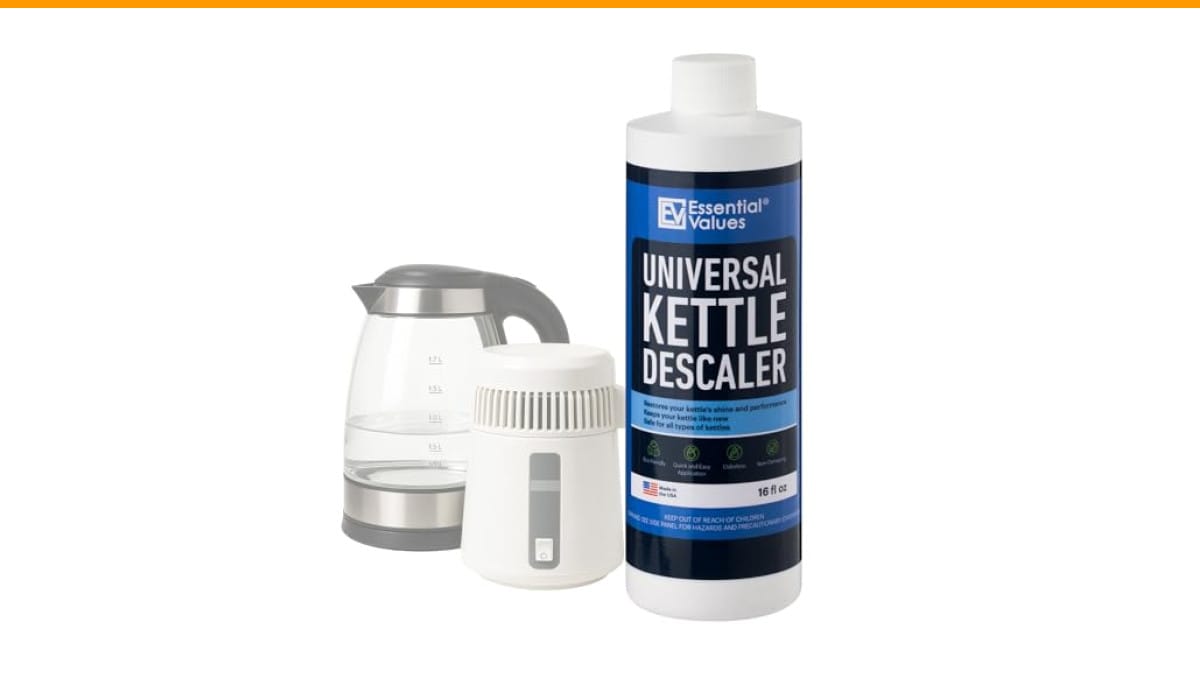
You’ll also learn a simple product that makes descaling painless — the Essential Values Universal Descaler, a liquid citric acid solution designed for kettles and coffee machines. But first, let’s understand what you’re up against.
The Hidden Cost of Hard Water in Your Gooseneck Kettle
Hard water contains dissolved calcium and magnesium. When you boil it, those minerals precipitate out and stick to surfaces as calcium carbonate — limescale. A gooseneck kettle concentrates this problem because it heats water quickly and repeatedly, and its narrow spout gives scale a perfect place to accumulate.
The hidden cost isn’t just aesthetic. A 2026 study in the International Journal of Scientific & Engineering Research found that a 1 mm layer of limescale can reduce heating efficiency by up to 10%. At 3 mm, that jumps to 25%. For a 1 kW kettle, that means every boil wastes more electricity and takes noticeably longer.
For specialty coffee drinkers, the bigger issue is taste. Scale deposits can flake off into your brew water, adding a chalky, mineral-heavy flavor that masks the delicate notes in your beans. And because gooseneck kettles are often used for pour-over, where water temperature and flow rate matter, any disruption to the spout ruins your technique.
What Hard Water Actually Does to Your Kettle (The Science)
Limescale Formation and Its Impact on Heating Elements
When water hardness exceeds 120 ppm (parts per million) — common in many US municipalities — scale forms quickly. The heating element in an electric gooseneck kettle is the hottest surface, so that’s where scale bonds first. Over time, the element becomes encased in a crust that acts as an insulator.
That insulation forces the element to work harder to transfer heat to the water. The result: boil time increases, energy consumption rises, and the element can overheat. In extreme cases, scale buildup leads to premature element failure, shortening your kettle’s lifespan by months or years.
I’ve seen kettles that took 7 minutes to boil instead of the original 4. That’s a 75% increase in wait time, and it’s not uncommon with heavy scale.
The Effect on Temperature Accuracy and Pour Precision
Most electric gooseneck kettles use a temperature sensor to maintain your target temp. Scale can coat that sensor, making it read the water temperature incorrectly. You might set 93°C but get 88°C or 98°C — both of which can ruin a pour-over.
The spout is another weak point. Scale buildup inside the narrow gooseneck restricts water flow, turning a smooth, controlled stream into a sputtering, drippy mess. That kills your pour-over technique, especially for methods like the V60 or Kalita Wave that rely on a steady, consistent flow rate.
You don’t need expensive equipment to test this. Fill your kettle with white vinegar, let it sit overnight, then pour it out and rinse. If the pour stream improves dramatically, scale was your problem.
5 Warning Signs Your Kettle Is Suffering from Scale Buildup
- Longer boil time. If your kettle takes 20-30% longer to boil than when it was new, scale is insulate the element.
- Visible white or chalky deposits on the interior walls, heating element, or spout.
- Unusual noises like popping or crackling during heating — that’s steam escaping through scale cracks.
- Cloudy or flaky water after boiling, especially if you see white particles in your coffee.
- Erratic temperature readings — the kettle shuts off early or overshoots your set temperature.
Any one of these signs means it’s time to descale. Ignoring them compounds the damage.
The Complete Descaling Playbook: Vinegar vs. Citric Acid vs. Commercial Descalers
You have three main options for removing limescale. Each has pros and cons, and the right choice depends on your kettle’s material and the severity of the buildup.
| Method | Effectiveness | Kettle Materials | Time Required | Residue/Taste | Cost per Use |
|---|---|---|---|---|---|
| White vinegar (1:1 with water) | Good for light to moderate scale | Stainless steel, glass, plastic — avoid on aluminum | 30-60 min soak plus boil | Strong vinegar smell, requires thorough rinsing | ~$0.10 |
| Citric acid powder (1-2 tbsp per liter) | Excellent for moderate to heavy scale | All common kettle materials | 15-30 min soak, then boil | Mild citrus scent, rinses clean | ~$0.15 |
| Commercial liquid descaler (like Essential Values) | Excellent, fast-acting, safe on all parts | All kettle types including temperature sensors | 5-15 minutes, no scrubbing | Minimal, food-safe, no lingering taste | ~$0.50-$1.00 |
Vinegar works but leaves a smell that can linger if you don’t rinse thoroughly. Citric acid powder is effective and cheap, but you need to dissolve it correctly. A commercial descaler like the Essential Values Universal Descaler is the easiest — you pour it in, boil, and rinse. It’s formulated with citric acid but includes surfactants that help break down scale faster, and it’s safe for the plastic and rubber components that vinegar can degrade over time.
How to Choose the Right Descaler for Your Kettle
If your kettle is stainless steel with no plastic parts, vinegar is fine. But if you have a gooseneck kettle with a temperature probe — most electric models do — use a commercial descaler or citric acid solution. The acid in vinegar can attack the probe’s seal over time.
For heavy scale that’s been building for months, skip vinegar. It’s too weak to break through thick crust. Go straight to a commercial descaler or a stronger citric acid solution (3 tablespoons per liter).
Step-by-Step Deep Cleaning for Stubborn Deposits
- Empty the kettle and rinse with fresh water.
- Add the descaler according to the label directions (for citric acid, use 1-2 tablespoons per liter of water).
- Fill with water to the max line, then boil.
- Let it sit for 15-30 minutes (or overnight for severe scale).
- Pour out the solution — don’t dump it down the sink without diluting it.
- Rinse the kettle thoroughly with fresh water, then boil and discard that water twice to remove any residue.
- Wipe the exterior and spout with a damp cloth to remove any scale that splashed out.
Repeat every 2-3 months, or more often if you have very hard water.
Prevention Strategies: Protecting Your Kettle and Your Coffee Flavor
Descaling is reactive. Prevention is proactive, and it saves you time and money in the long run.
Water Filtration Options for Coffee Enthusiasts
The best defense against hard water effects on electric gooseneck kettle performance is using water with lower mineral content. A simple pitcher filter like Brita removes some hardness but not all. For specialty coffee, consider a dedicated water recipe like Third Wave Water, which adds minerals back in the right proportions for brewing. That water is formulated to reduce scale while improving coffee extraction.
If you’re on a budget, a countertop distiller or a reverse osmosis system gives you complete control. I use a 50/50 mix of distilled and tap water — it reduces scale dramatically while keeping some minerals for flavor.
Daily Habits That Minimize Scale Accumulation
- Don’t leave water sitting in the kettle overnight. Empty it after each use.
- Use filtered water when you can. Even a basic filter cuts hardness by 30-50%.
- Wipe the spout and rim after pouring — scale forms where water dries.
- Consider a water softener for your whole house if your water is above 180 ppm.
These habits take 10 seconds a day and can double your kettle’s lifespan.
The Financial Impact: Energy Waste and Kettle Replacement Costs
Let’s put numbers on this. A typical electric gooseneck kettle uses 1000-1200 watts. If you brew twice a day, that’s about 2-3 kWh per week. With a 1 mm layer of scale, you’re wasting 10% of that energy — roughly 0.2-0.3 kWh per week. Over a year, that’s 10-15 kWh wasted, costing you an extra $1.50 to $3.00 depending on your electricity rate. Not huge, but it adds to the replacement cost.
A good gooseneck kettle costs $50-$150. If scale ruins it in 18 months instead of 5 years, that’s a real loss. Plus, scale can void your warranty. Most manufacturers consider limescale damage a misuse and won’t cover it. Check your warranty — many explicitly exclude scale damage.
So the cost of a $10 bottle of descaler or a $20 filter is trivial compared to the cost of replacing a kettle every year.
Troubleshooting: When Descaling Isn’t Enough
If you descale regularly and your kettle still underperforms, the problem might not be scale. The temperature sensor could be permanently damaged. To check, heat water to a set temperature and measure it with a reliable thermometer. If it’s off by more than 2-3°C after descaling, the sensor is likely faulty.
Another issue is a clogged spout. Use a thin brush or a toothpick to gently remove any remaining scale inside the spout. If the flow is still weak, the spout might have a physical blockage that needs more aggressive cleaning.
If your kettle is more than 3-4 years old and has been through heavy hard water use, replacement might be more cost-effective than continued repairs. That’s a decision only you can make, but don’t let a $100 kettle ruin your morning coffee for months.
Frequently Asked Questions About Hard Water and Gooseneck Kettles
Can hard water permanently damage my gooseneck kettle?
Yes. Over time, scale can corrode the heating element and temperature sensor, leading to failure. It can also clog the spout beyond repair. Regular descaling prevents this.
How often should I descale my electric gooseneck kettle?
Every 2-3 months if you use tap water, or every 6 months if you use filtered water. If you notice visible scale or longer boil times, descale immediately.
Is it safe to use vinegar in a gooseneck kettle?
Yes, for stainless steel kettles without plastic parts. But vinegar can damage rubber seals and plastic components over time. Use a commercial descaler or citric acid for those kettles.
Will using filtered water eliminate the need for descaling?
It reduces scale buildup significantly but doesn’t eliminate it. Even filtered water contains some minerals. You’ll still need to descale occasionally, just less often.
Can I use a descaler in a kettle with a temperature probe?
Yes, but choose a descaler that’s safe for all components. The Essential Values Universal Descaler is formulated to be safe for temperature sensors and other sensitive parts. Always rinse thoroughly after descaling.
Final Verdict: Is Hard Water Worth Worrying About?
- Hard water effects on electric gooseneck kettle performance are real and measurable — expect up to 25% efficiency loss with thick scale.
- Scale ruins pour precision and temperature accuracy, directly hurting your coffee quality.
- Descale every 2-3 months with a method that matches your kettle’s material. Citric acid or commercial descalers are the safest all-around choices.
- Prevent scale by using filtered or specially formulated water, and empty your kettle after each use.
- The cost of descaling is pennies per use compared to the cost of a new kettle.
- If your kettle is over 3 years old and still underperforms after descaling, consider replacing it.
- Don’t ignore the warning signs — early intervention saves your kettle and your morning routine.
Hard water is a nuisance, but it’s a manageable one. With a simple descaling routine and a little attention to water quality, your gooseneck kettle can deliver precise, delicious pour-over coffee for years. And when you need a reliable descaler, the Essential Values Universal Descaler is a solid choice — check its current price on Amazon if you’re interested.
For more tips on keeping your coffee gear in top shape, explore our grinder guide or read about common espresso machine problems that also stem from water quality issues.
Products related to this article
Sponsored / affiliate links. As an Amazon Associate I earn from qualifying purchases. I may earn additional commission from eligible campaigns.
 SOLUSTRE Electric USB Coffee Cup Warmer with Temperature Settings Portable Milk and Beverage Heating Coaster for Office Desk Small Lightweight Design Easy to Clean Surface Multi Functional
 Bring It On Cleaner Hard Water Stain Remover for Shower Glass, 32 fl oz
 Stainless Steel Moka Pot Pressed Powder Tool for 2 4 6 9 Cup Espresso Coffee Brewer(6 Cups)