You pull a double shot, steam your milk, and pour a latte that rivals your local café. Then the utility bill arrives, and you wonder if that daily ritual is quietly draining your wallet. It’s a fair question. Most people assume a 1350-watt machine is an energy hog, but the math is often more forgiving than you’d expect.
This guide breaks down exactly what an espresso machine with a milk frother costs to run. We’ll look at the wattage split between brewing and steaming, calculate the cost per cup, per month, and per year, and compare it to other coffee makers. You’ll walk away knowing whether your morning habit is a budgeting problem or a rounding error.
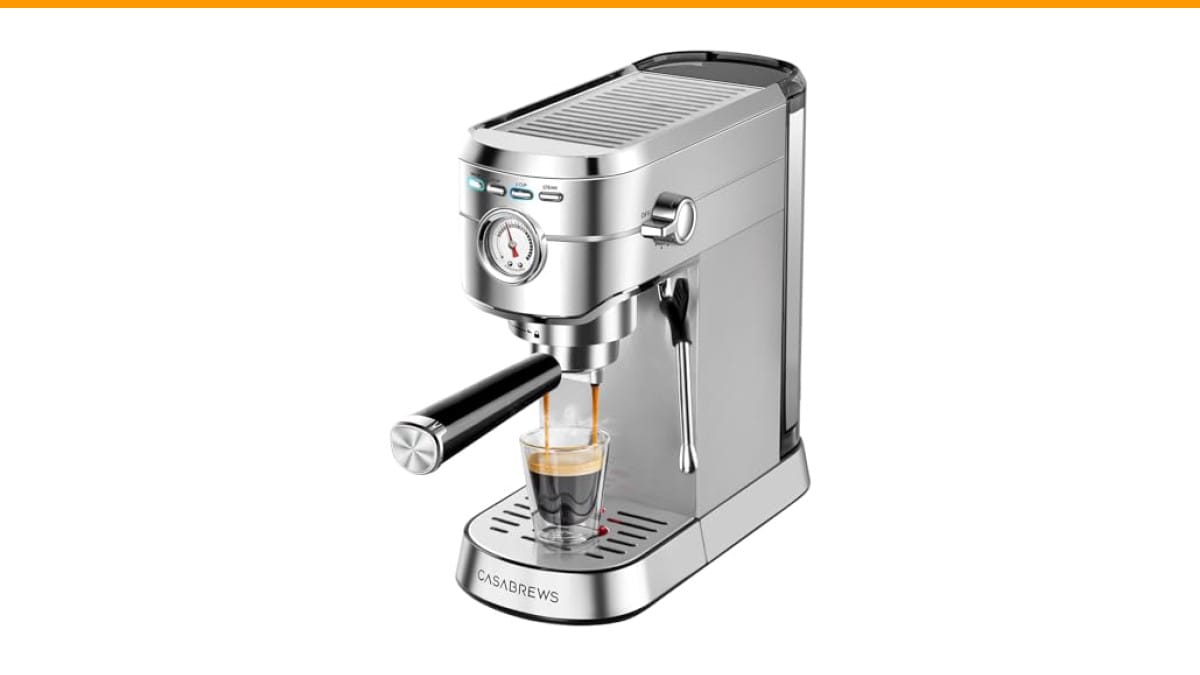
If you’re shopping for a machine that balances power and efficiency, the CASABREWS CM5418 Compact Espresso Machine fits the bill. It packs a 1350 W boiler and a 20-bar pump into a small footprint, making it a practical option for home baristas who want café quality without the counter space.
The Short Answer: How Much Does One Latte Cost in Electricity?
Here’s the number you care about: a single latte costs roughly 1 to 2 cents in electricity. That’s it. Even with a powerful 1350 W machine, the active brewing and steaming time is so short that the total energy draw stays small.
Let’s do the math. A typical espresso shot takes about 30 seconds of pump time. Steaming milk for a latte takes another 45 to 60 seconds. That’s roughly 90 seconds of active use at 1350 W. In kilowatt-hours, that’s 1350 W × 0.025 hours = 0.034 kWh. At the US average rate of $0.17 per kWh, that’s about $0.006 per drink. Round up for heat-up time, and you’re still under two cents.
The real cost driver isn’t the brewing. It’s the idle time. A machine left on for two hours burns more electricity than a month of morning lattes. We’ll dig into that later.
Breaking Down the Wattage: Brew Boiler vs. Steam Thermoblock
Most people think of an espresso machine as one unit that draws a single wattage. In practice, the power splits into two distinct jobs: brewing and steaming. Understanding this split explains why your machine’s energy use fluctuates so much during a single drink.
The brew cycle uses the pump to push water through the coffee at 9 to 20 bars of pressure. This is a relatively short burst. The pump draws maybe 100 to 200 W, while the heating element maintains temperature in the boiler. For a single shot, the total brew energy is small.
The steam cycle is a different beast. To turn water into steam, the machine must heat water well past boiling, often to 250°F or higher. That requires a separate thermoblock or a boiler temperature spike. This is where the wattage climbs. A machine like the CASABREWS CM5418 draws its full 1350 W during steaming to generate enough pressure and heat.
Why the Milk Frother Doubles the Energy Draw
Here’s the catch: frothing milk isn’t just about the steam wand. The machine has to heat water from brew temperature (around 200°F) up to steam temperature (above 250°F). That temperature swing takes energy. On many machines, this means the heating element runs continuously for 30 to 60 seconds, drawing full power the entire time.
Compare that to a drip coffee maker, which heats water once and lets gravity do the work. A drip machine draws 600 to 900 W but only for the brew time. An espresso machine with a frother draws more power for a shorter window, but the peak demand is higher. That’s why you’ll see the wattage listed as 1350 W on the spec sheet, even though the average consumption over a session is much lower.
If you make a cappuccino, the steam wand runs longer than the brew pump. That means the frother is often the dominant energy consumer in the whole process. A quick steam burst for 20 seconds uses about 0.0075 kWh. Extend that to a minute for a large pitcher of milk, and you’re at 0.0225 kWh. The milk frothing can easily cost more than the espresso shot itself.
The Real Cost: Per Drink, Per Day, Per Month, Per Year
Let’s put real numbers on this. We’ll use a 1350 W machine, a $0.17 per kWh electricity rate, and a few different usage patterns. The table below shows what you’d expect to pay.
| Usage Pattern | Active Time per Drink | Energy per Drink (kWh) | Cost per Drink | Monthly Cost (30 Days) | Annual Cost |
|---|---|---|---|---|---|
| Single espresso, no milk | 45 sec | 0.017 | $0.003 | $0.09 | $1.10 |
| Latte with steamed milk | 90 sec | 0.034 | $0.006 | $0.17 | $2.10 |
| Two lattes per day | 180 sec | 0.068 | $0.012 | $0.35 | $4.20 |
| One latte + 30 min standby | 90 sec + idle | 0.084 | $0.014 | $0.43 | $5.20 |
| Machine on 2 hours daily | Idle only | 0.30 | $0.051 | $1.53 | $18.60 |
Notice the pattern. The cost of actually making coffee is negligible. The cost of leaving the machine on dwarfs everything else. A machine that sits hot for two hours a day costs nine times more than one that’s turned off after each use.
One more angle: the cost per cup. If you’re the type who makes a single daily latte, your annual electricity bill for coffee is about $2 to $3. That’s less than the price of one café latte. Even if you’re a heavy user making four drinks a day, you’re looking at maybe $8 to $10 a year. The machine pays for itself in avoided café trips within a month.
The Standby Trap: Why Idle Time Costs More Than Brewing
Here’s the myth-buster. Most people think the brew boiler is the energy hog. It’s not. The standby mode is. A machine that maintains temperature at 200°F will cycle its heating element on and off all day. Each cycle draws full wattage for 10 to 20 seconds, and those cycles add up.
A typical espresso machine in standby draws 50 to 100 W on average. That doesn’t sound like much, but it runs 24/7 if you leave it plugged in. Over a year, that’s 438 to 876 kWh. At $0.17 per kWh, that’s $75 to $150 annually. Compare that to the $2.10 you spend actually brewing lattes. The standby cost is 40 to 70 times higher.
The fix is simple: unplug the machine or turn it off at the wall when you’re done. A machine with a mechanical switch cuts power completely. A machine with a digital display might still draw a few watts in standby, so a smart plug is the better solution for those.
If you’re the type who leaves the machine on for convenience, consider the trade-off. You’re paying $10 to $15 a month just for the privilege of having hot water ready. That’s the equivalent of buying one extra latte per month. Some people find that worth it. Most don’t.
Espresso Machine vs. Drip vs. Standalone Frother: The Efficiency Showdown
How does an espresso machine with a frother stack up against other brewing methods? We compared a few common setups side by side. The results might surprise you.
| Method | Typical Wattage | Energy per Cup (kWh) | Cost per Cup | Annual Cost (1 cup/day) |
|---|---|---|---|---|
| Espresso machine with frother | 1350 W | 0.034 | $0.006 | $2.10 |
| Drip coffee maker | 800 W | 0.10 | $0.017 | $6.20 |
| Pour-over with electric kettle | 1500 W | 0.05 | $0.009 | $3.10 |
| Standalone milk frother | 500 W | 0.02 | $0.003 | $1.10 |
| French press with microwave | 1000 W | 0.03 | $0.005 | $1.80 |
The espresso machine isn’t the most efficient option, but it’s far from the worst. A drip coffee maker actually uses more energy per cup because it keeps the heating plate warm for 30 to 60 minutes. The espresso machine’s advantage is speed: it heats up, brews, and steams in under two minutes, then shuts off.
The standalone frother is the cheapest option if you already have an espresso machine without a steam wand. But for most home users, the integrated frother on a machine like the CASABREWS CM5418 eliminates the need for a second appliance. That saves counter space and avoids the extra standby draw of a separate device.
If you’re weighing a super-automatic against a semi-automatic, the energy difference is minor. Super-automatics draw similar wattage but often have a longer heat-up time. The bigger factor is whether the machine’s eco mode actually cuts power or just lowers the boiler temperature. Check the manual before you assume it’s saving you money.
How to Slash Your Espresso Machine’s Electricity Bill by 40%
You can’t change the physics of heating water, but you can change how often your machine does it. Here are the practical steps that actually move the needle.
The Smart Plug Hack
Put your espresso machine on a smart plug. Set a schedule that turns it on 10 minutes before your usual morning brew time and off 30 minutes after you finish. This eliminates standby draw for the other 22 hours of the day. A $15 smart plug pays for itself in a few months if you’re currently leaving the machine on.
The key is picking a plug rated for the machine’s wattage. Most smart plugs handle 15 amps, which covers a 1350 W machine at 120V. Don’t daisy-chain anything. Plug the machine directly into the smart plug.
The “Turn It Off” Rule
If you don’t want to buy a smart plug, just flip the switch on the machine or the power strip after every use. For machines with a mechanical toggle switch, this cuts power completely. For machines with a digital standby, unplug it or use a switched power strip. This simple habit alone can cut your annual coffee electricity cost by 40% or more, depending on how long you usually leave it on.
One more tip: don’t preheat the machine for longer than necessary. Most modern machines reach brew temperature in 30 to 60 seconds. The old advice about letting it warm up for 20 minutes was for commercial machines with massive boilers. Your home machine doesn’t need that, and it’s just burning electricity while you wait.
FAQ: Quick Answers on Espresso Machine Power Use
Does a higher wattage machine use more electricity?
Not necessarily. Wattage is a measure of power draw, not total energy. A 1350 W machine that runs for 2 minutes uses less energy than a 900 W machine that runs for 5 minutes. The total energy is what matters, and that depends on how long the heating element is active. A higher wattage machine often heats up faster, which can actually make it more efficient for short sessions.
Is it cheaper to use a milk frother or steam wand?
A standalone milk frother uses less electricity per use because it only heats a small amount of milk. The steam wand on an espresso machine draws the full machine wattage and requires the boiler to reach a higher temperature. However, the difference per drink is fractions of a cent. The convenience of an integrated steam wand usually outweighs the negligible cost difference.
How much does it cost to leave an espresso machine on all day?
If your machine draws 50 W in standby and you leave it on for 12 hours a day, that’s 0.6 kWh per day. At $0.17 per kWh, that’s $0.10 per day, or about $3.10 per month, $37 per year. If you leave it on 24/7, double those numbers. That’s the hidden cost most people overlook.
Does the voltage of my outlet matter?
Yes. A US 120V machine draws roughly double the amps of a European 240V machine for the same wattage. That means the wiring and breaker capacity matter more at 120V. The energy consumption is the same in kWh, but the heat-up time can be slightly longer on 120V systems due to lower current delivery. It’s a minor difference, not a deal-breaker.
Can I measure my machine’s actual power use?
Yes, a simple plug-in watt meter costs about $20 and shows real-time wattage and cumulative kWh. Plug your espresso machine into it for a week and you’ll have exact numbers for your usage pattern. This is the most accurate way to know what you’re spending, since it accounts for your specific machine, water temperature, and brew time.
The Bottom Line: Is It Worth the Watts?
Here’s the honest take after running the numbers. An espresso machine with a milk frother is not an energy vampire. The actual brewing and steaming cost you pennies a day. The real expense is idle time, and that’s entirely within your control.
If you’re making one or two drinks a day and turning the machine off afterward, your annual electricity cost is under $5. That’s less than the price of a single café latte. The machine’s energy footprint is a rounding error in your household budget.
The bigger energy question is whether you’re using the machine efficiently. A few small habits make a real difference:
- Turn the machine off at the wall after every session to eliminate standby draw.
- Use a smart plug with a schedule to automate power-off times.
- Don’t preheat longer than 60 seconds for home machines.
- Consider a machine with a mechanical switch instead of a digital standby mode.
- If you’re comparing models, look at heat-up time, not just wattage. Faster heat-up means less wasted energy.
- Skip the separate milk frother unless you already own one; the integrated wand is efficient enough.
- Check your electricity rate. If you’re on time-of-use pricing, brew during off-peak hours to save a bit more.
At the end of the day, the espresso machine with a frother is one of the cheapest ways to get café-quality coffee at home. The electricity cost is so low it shouldn’t factor into your decision. Buy the machine you’ll actually use, turn it off when you’re done, and enjoy your latte without guilt.
Products related to this article
Sponsored / affiliate links. As an Amazon Associate I earn from qualifying purchases. I may earn additional commission from eligible campaigns.
 Coffee Espresso Machine Handle Replacement Parts, Cafe Bracket Handle for Lidl Silvercrest CM4621 CM4218 KF5002 KF500S Barista (for 51mm Portafilter Basket - Not included)
 HomeBeyond Espresso Coffee Maker 12 Cups, Classic Stovetop Espresso Maker, 600ml / 20oz Coffeemaker for Gas & Ceramic Stovetops (Silver)
 Quick Heating Cup Warmer, Three Temperature Settings, Splashproof and Portable, for Coffee, Milk, Lightweight ABS Material