You’ve just pulled a shot that looks like a Jackson Pollock painting — coffee spraying everywhere, blonding in five seconds, and a puck that sticks to the group head like glue. You blame the grinder, the beans, the machine. But sometimes, the real culprit is the small metal disc in your hand: the tamper.
Most home baristas treat the tamper as an afterthought. They grab whatever came with the machine or whatever looks cool on Amazon. That’s a mistake. The tamper is the last thing that touches your coffee before water does. It shapes the puck’s density, and that density determines how evenly water flows through the grounds. Get it wrong, and you’ll chase extraction problems that no grinder adjustment can fix.

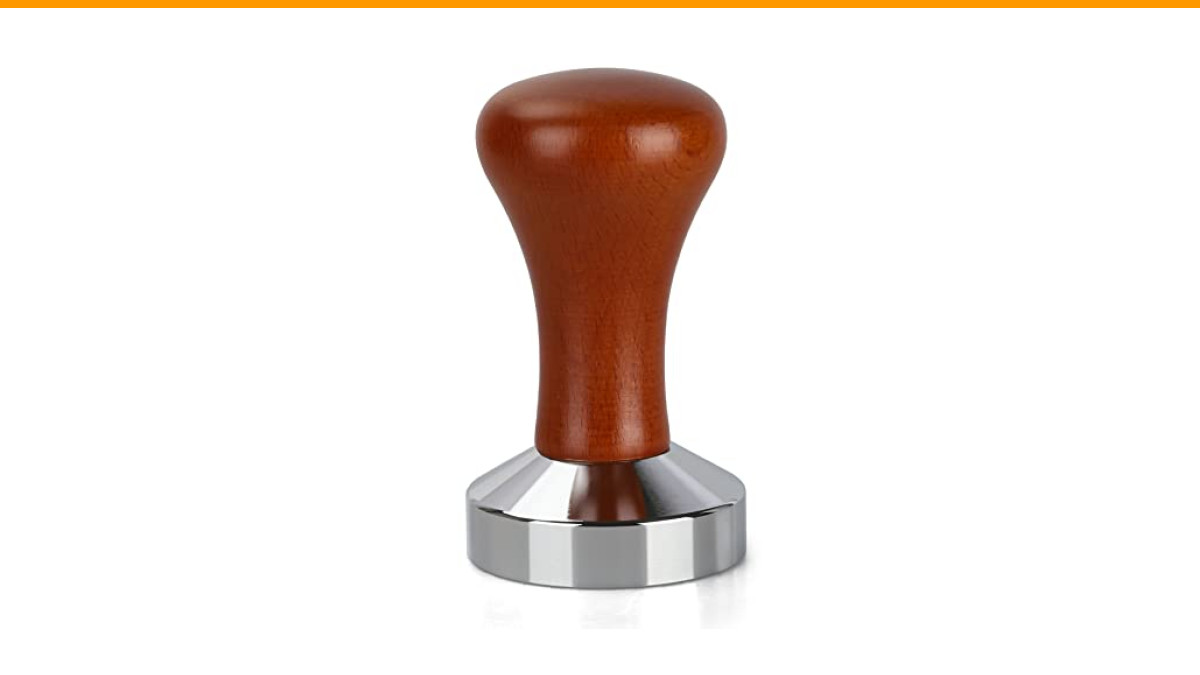
WYLOSUA
51mm Espresso Tamper-Premium Barista Coffee Tamper Coffee…
- THE DIAMETER OF THIS TAMPER IS 51MM - please check that this will fit your filter basket before purchasing.Fits all 51mm Commercia…
- UNIQUE DESIGN - The tamper has an exquisite appearance, Stainless steel design, the handles were ergonomically designed to ensure…
- PROFESSIONAL HANDMADE - Due to the high quality of the steel espresso control, the tamper has an ideal size and weight, because of…
As an Amazon Associate I earn from qualifying purchases.
This guide walks you through how to choose an espresso tamper with a fit-first approach. You’ll learn how to measure your basket’s inner diameter, why a few millimeters of wiggle room matter, what different tamper types actually do, and when spending more money is worth it. By the end, you’ll know exactly which tamper fits your setup — no guesswork.
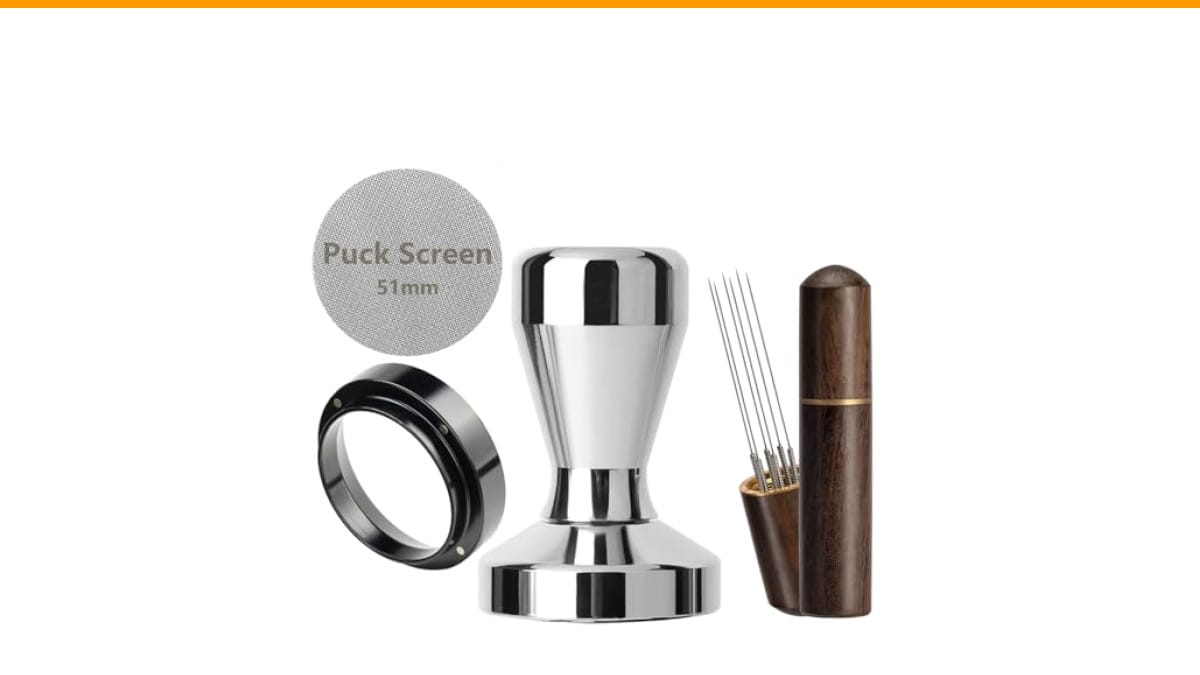
If you’re using a 51mm portafilter (common on many home machines like Delonghi and some EC series), a solid choice is the WYLOSUA 51mm Espresso Tamper. It has a stainless steel flat base and a solid wood handle, built for comfort and even pressure distribution. It’s a good starting point if your basket measures close to 51mm.
Why Your Tamper Matters More Than Your Grinder (Almost)
You can own a $2,000 grinder and still pull terrible shots if your tamper doesn’t fit your basket. Here’s why: when you tamp, you’re compressing coffee grounds into a uniform bed. Water under pressure (9 bars) will always find the path of least resistance. If your tamper is too small, the edges of the puck are less dense than the center. Water rushes through those edges, causing channeling — thin streams of water that carve through the puck and under-extract the coffee. If your tamper is too large, it can get stuck in the basket, or worse, damage the basket’s walls.
The grinder determines particle size distribution. The tamper determines how those particles are arranged. Both matter, but the tamper is cheaper to fix and easier to get right. A $30 tamper that fits perfectly will outperform a $200 tamper that’s the wrong size.
So, before you even think about tamper types or handles, you need to know your basket’s inner diameter. It’s the single most important factor in choosing a tamper.
The 3 Tamper Types That Actually Matter (Flat, Spring-Loaded, Palm)
You’ll see dozens of tamper designs online, but they all fall into three functional categories. Each has a different purpose, and each suits a different workflow.
Flat vs. Convex: Why Flat Wins for Modern Baskets
Flat tampers have a perfectly flat base. Convex tampers have a slight dome. The dome was popular in the 1990s because it supposedly helped prevent donut extraction (where the center of the puck extracts slower than the edges). But modern baskets, especially precision baskets like VST or IMS, are designed for flat tampers. A convex base creates an uneven density that can cause the opposite problem: under-extraction in the center. If you’re using a standard basket that came with your machine, flat is still the safer bet. It’s easier to get a level, uniform tamp.
Calibrated vs. Manual: Is Consistency Worth the Price?
A calibrated tamper clicks or stops at a set pressure, usually 30 pounds. A manual tamper relies on your muscle memory. The question is whether you need that consistency. If you’re a home barista pulling one or two shots a day, you can train your hands to apply consistent pressure. It’s not that hard. But if you’re pulling multiple shots back-to-back, or if you’re trying to dial in a new coffee, a calibrated tamper removes one variable. It costs more, but it also speeds up your workflow.
Spring-loaded tampers are a subset of calibrated ones. They use a spring mechanism to limit pressure. They’re not magic — they still require you to keep the tamper level. But they do take the guesswork out of pressure.
Palm tampers are designed to fit in the palm of your hand, using your body weight instead of wrist strength. They’re popular among baristas who pull dozens of shots a day because they reduce wrist strain. But they’re bulkier and harder to store. For a home user, they’re overkill unless you have wrist issues.
The Non-Negotiable: Matching Tamper Size to Your Basket
This is the part most guides gloss over. They say “measure your basket” but don’t tell you how. Let’s fix that.
How to Measure Your Portafilter Basket (With and Without Calipers)
The most accurate way is with digital calipers. They cost about $15 and are worth every penny. Here’s the process:
- Remove the basket from the portafilter. It should pop out from the top.
- Place the caliper jaws inside the basket, spanning the inner diameter. Measure at the top edge, not the bottom. The top edge is where the tamper sits.
- Take three measurements at different points (e.g., 0°, 120°, 240°) and average them. Baskets can be slightly out of round.
- Write down the number. That’s your target tamper size.
No calipers? You can use a ruler, but you’ll be guessing to the nearest millimeter. Better approach: look up the spec for your specific machine model. But beware — many machines share the same basket size across different models. Breville’s 54mm basket is used across the Barista Express, Pro, and Bambino lines. Gaggia Classic and Rancilio Silvia both use 58mm baskets. But there are exceptions. The Delonghi Dedica uses a 51mm basket, which is less common.
The Wiggle Room Rule: Why 58.5mm Fails on a 58mm Basket
Here’s the rule: your tamper should be 0.5mm to 1mm smaller than your basket’s inner diameter. If your basket measures 58.0mm, a 58.5mm tamper is too big. It won’t even fit. A 58.4mm tamper might fit, but it’ll create a suction effect when you pull it out — the vacuum can disturb the puck. A 57.5mm tamper is too small, leaving a gap around the edges that causes channeling.
The sweet spot is 57.5mm for a 58mm basket. That gives you about 0.5mm of clearance on each side. Enough to slide in and out smoothly, but not so much that coffee grounds sneak around the edges.
Precision baskets like VST or IMS have tighter tolerances. They’re often labeled 58.0mm but measure 58.4mm or 58.5mm. That’s why you’ll see tampers sold in 58.3mm, 58.4mm, and 58.5mm sizes. If you’re using a stock basket, stick with the standard 58mm tamper. If you upgrade to a precision basket, you’ll likely need a slightly larger tamper. Measure before you buy.
Tamper Size Chart for Popular Machines
Here’s a quick reference for common machines. Remember, these are typical sizes — always measure your own basket if you can.
| Machine Brand/Model | Basket Size (Typical) | Recommended Tamper Size |
|---|---|---|
| Breville (Barista Express, Pro, Bambino) | 54mm | 53.5mm |
| Gaggia Classic, Rancilio Silvia | 58mm | 57.5mm |
| Delonghi Dedica, EC680, EC685 | 51mm | 50.5mm |
| La Marzocco, Rocket, ECM (E61 group) | 58mm | 57.5mm or 58.3mm (for precision baskets) |
| Flair Espresso (Pro 2, 58) | 58mm | 57.5mm |
If you have a machine not listed here, a quick search for “[your machine model] portafilter basket size” will usually turn up the spec. But again, measuring is the only way to be sure.
Ergonomics and Build Quality: The 5-Minute Test
You’ll be tamping every day, possibly multiple times. A tamper that feels awkward in your hand will make you dread the process. Here’s a quick test you can do in a store or at home:
- Grip: Hold the tamper like you would a door handle. Your fingers should wrap around the handle comfortably, without stretching or cramping. The handle should have some texture — wood, knurled metal, or rubber — so it doesn’t slip when your hands are slightly oily.
- Weight: A good tamper should feel substantial but not heavy. Most quality tampers weigh between 300g and 500g. Too light, and you’ll have to push harder. Too heavy, and you’ll tire your wrist.
- Balance: The weight should be centered over the base, not in the handle. If the tamper tips forward when you hold it, it’s handle-heavy, which makes leveling harder.
- Base edge: Run your finger along the edge of the base. It should be smooth, not sharp. A sharp edge can catch on the basket and scratch it.
I’ve tested tampers that look beautiful but are impossible to use for more than a week. The handle is too thin, or the base is too light. Don’t fall for aesthetics alone. Spend five minutes holding it and doing a few practice tamping motions. If it doesn’t feel right, it’s not the tamper for you.
Budget Breakdown: What $20, $50, and $100 Get You
Tamper prices range from $10 to over $200. Here’s what you actually get at each price point.
- $20–$30: A basic aluminum or stainless steel tamper with a plastic or wood handle. The base is usually flat and uncoated. It’ll do the job, but the fit might not be perfect, and the handle might not be comfortable for long sessions. This is where the WYLOSUA 51mm tamper sits — it’s a solid budget option that gets the fundamentals right.
- $50–$80: Better build quality, often with a stainless steel base that’s precisely machined. Handles are ergonomic, and some are calibrated. This is the sweet spot for most home baristas. You get a tamper that fits well and feels good in your hand without breaking the bank.
- $100+: Premium materials like walnut or titanium, plus features like self-leveling or adjustable depth. These are nice, but they don’t make better espresso than a $50 tamper that fits correctly. You’re paying for aesthetics and precision machining.
My advice: if you’re on a budget, spend $30 on a tamper that fits your basket. If you have $80, get a calibrated one. Don’t spend $200 unless you’re a collector or you want a specific look.
Troubleshooting: 3 Signs Your Tamper Is the Wrong Size
You might already own a tamper and suspect it’s not right. Here are three common symptoms and what they mean.
- Channeling (sprays from the bottom of the portafilter): If your shots look like a sprinkler, your tamper is likely too small. The edges of the puck are under-dense, so water flows through them. Fix: get a tamper that’s 0.5mm–1mm smaller than your basket.
- Donut extraction (coffee drips from the edges, not the center): This suggests the center of the puck is too dense. It can happen with a convex tamper or if your tamper is too large and compresses the edges more. Fix: switch to a flat tamper or check your size.
- Stuck puck (the puck sticks to the group head after brewing): This is often a sign of over-tamping or a tamper that’s too large, creating a vacuum. Fix: reduce pressure and make sure your tamper fits with a little wiggle room.
If you’re still getting inconsistent shots after fixing your tamper, check your espresso extraction basics — sometimes the grind is the issue, not the tamp.
Final Verdict: The Best Tamper for Your Skill Level
Here’s a simple decision tree:
- Beginner: Buy a flat, uncalibrated tamper that fits your basket. Spend $20–$30. Learn to tamp level and consistent by feel.
- Intermediate: Get a calibrated tamper (spring-loaded or click-based) in the correct size. This removes pressure variability and speeds up your workflow.
- Advanced: Consider a self-leveling tamper or a palm tamper if you pull many shots. But remember, the size still has to be right.
Don’t forget to check your machine’s compatibility. If you have a semi-automatic machine, tamping is a manual skill you need to master. If you have a fully automatic, you might not need a tamper at all.
FAQ: Quick Answers on Tamper Sizes and Types
What size tamper do I need for a Breville Barista Express?
Breville uses a 54mm basket. You need a 53.5mm tamper. That gives you 0.5mm of clearance on each side, which is perfect.
Can I use a 58mm tamper on a 54mm basket?
No. It won’t fit. The tamper is larger than the basket. You’d damage both trying to force it.
What is the ideal tamping pressure?
Most experts recommend 30 pounds of pressure. That’s a firm push, not a maximum effort. A calibrated tamper can help you hit this consistently.
Does a convex tamper work better than a flat one?
No. Modern baskets are designed for flat tampers. Convex tampers can cause uneven extraction. Stick with flat unless you have an older basket that’s specifically designed for a convex shape.
How do I know if my tamper is too small?
If your shots channel or spray, and you’ve ruled out grind issues, your tamper is probably too small. Measure your basket’s inner diameter and compare it to your tamper. You should have 0.5mm–1mm of clearance.
What to Do Next
You now know the two things that matter most: the size and the type. Everything else is preference.
- Measure your basket with calipers before buying any tamper.
- Choose a flat base for modern baskets.
- Get a calibrated tamper if you want consistency without practice.
- Test the grip and weight before you commit.
- Spend $30–$50 for a quality tamper that fits.
- If you have a 51mm machine, the WYLOSUA 51mm tamper is a reliable option.
- If your shots are still bad after fixing the tamper, check your grind and dose.
That’s it. Go measure your basket, and you’ll never buy a wrong tamper again.
Products related to this article
Sponsored / affiliate links. As an Amazon Associate I earn from qualifying purchases. I may earn additional commission from eligible campaigns.
 Coffee Espresso Machine Handle Replacement Parts, Cafe Bracket Handle for Lidl Silvercrest CM4621 CM4218 KF5002 KF500S Barista (for 51mm Portafilter Basket - Not included)
 AirheadStorm Coffee Espresso Moka Stove Pot Handle, Mocha Pot Handle, Moka Express Handle Replacement Handle Parts for Espresso Pots 1 3 6 9-12 Cups(6 Cup)
 Linnkyfloa Coffee Espresso Maker Handle Replacement for Stovetop Moka Pot or Percolator, Black Plastic for Spare Part Compatible with Italian(9-12 Cup)