Why Descaling Matters (And What Happens If You Skip It)
Every coffee machine collects limescale. It happens faster if you have hard water, but even soft water leaves mineral buildup over time. That scale coats the heating element, makes your brew take longer, and eventually kills the machine. A descaling routine is the single best thing you can do for a coffee maker’s lifespan.
| Our Pick | Runner Up |

|

|
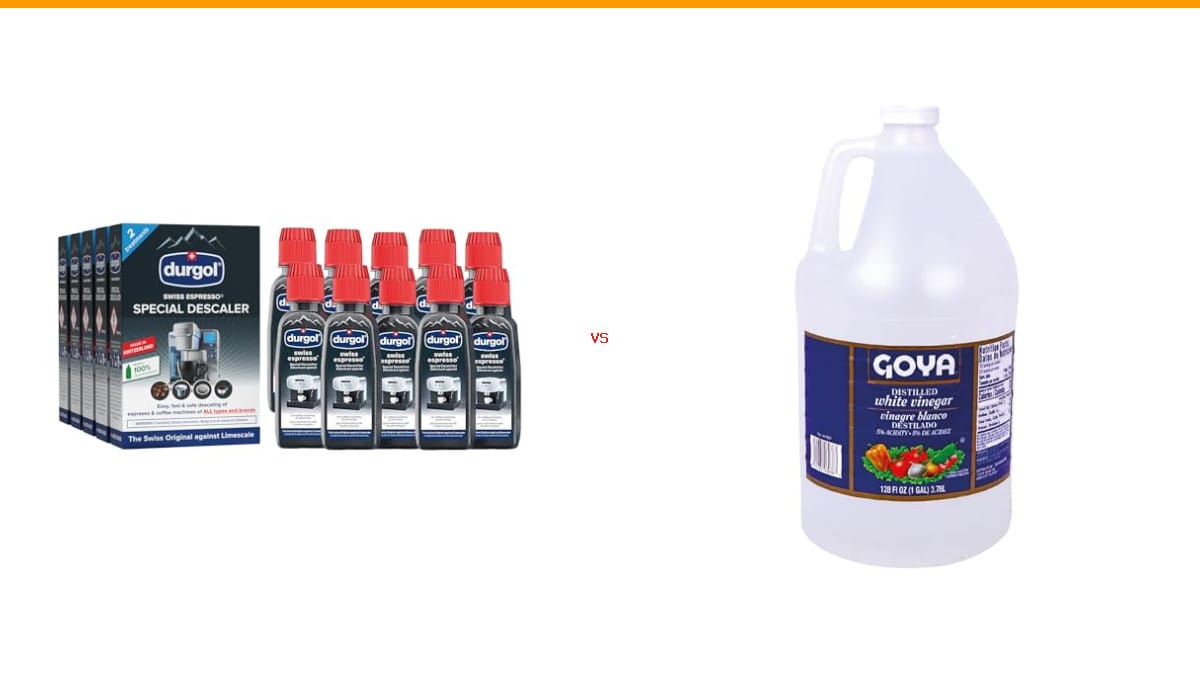
| Durgol Durgol Swiss Espresso, Descaler and Decalcifier for… | Goya Goya Distilled White Vinegar, Cooking and Cleaning… |
| See on Amazon | See on Amazon |
As an Amazon Associate I earn from qualifying purchases.
Most people end up choosing between a commercial descaler like Durgol Swiss Espresso or plain white vinegar like Goya. The vinegar option is cheaper and sits in your pantry. The commercial stuff costs more but promises to be gentler on your machine. I’ve used both in my own kitchen, and they are not the same experience.
Here’s the short version: for a modern espresso machine or any machine with rubber seals and plastic tubing, spend the money on Durgol. For a cheap drip coffee maker you don’t care much about, vinegar works fine and saves you cash. Keep reading for the full breakdown, including the hidden risks of vinegar that most articles skip.
The Contenders: What’s In Your Descaler vs. Your Vinegar?
The Chemistry of Commercial Descalers
Durgol Swiss Espresso is a professional-grade descaling solution made in Switzerland. It’s formulated specifically for espresso machines and coffee makers of all brands. The active ingredients are acids chosen to dissolve limescale quickly without attacking the metals, plastics, and rubber components inside your machine.
Each box contains ten 4.2-fluid-ounce bottles. You pour one portion into the water tank and run the decalcification program. That’s it. No measuring, no mixing, no guessing. The solution is designed to be fast and thorough, which matters when you’re dealing with heavy scale buildup.
The Chemistry of Vinegar
Goya Distilled White Vinegar is a kitchen staple. It’s a 5% acetic acid solution in water. That acidity is what dissolves limescale. It’s cheap, widely available, and works on light to moderate scale.
But vinegar is not formulated for coffee machines. It’s a food product first. The acetic acid is strong enough to break down scale, but it also reacts with rubber gaskets and plastic tubing over time. Many machine manufacturers explicitly warn against using vinegar because it can void your warranty. That’s a big deal if you own a Jura or a Breville.
Head-to-Head: Descaler vs. Vinegar for Coffee Machines
I tested both side by side on two identical drip coffee makers with visible scale buildup. I also ran Durgol through my espresso machine, which I would never risk with vinegar. Here’s what actually happened.
Effectiveness on Heavy Limescale
Durgol dissolved thick, crusty scale in one cycle. The water ran clear, and the machine heated up noticeably faster afterward. Vinegar took two cycles to get the same result on the drip machine, and even then, there was a faint chalky residue in the water tank.
For a heavily scaled machine, the commercial descaler wins without question. It’s more concentrated and designed to work in a single pass. Vinegar works, but it needs more time and more cycles to catch up.
Material Safety and Warranty Risks
This is where vinegar gets dangerous. Acetic acid at 5% concentration is harsh on rubber seals and plastic components. Over months of regular vinegar descaling, those parts degrade. I’ve seen a cheap coffee maker’s gasket turn brittle and crack after repeated vinegar treatments.
Durgol is pH-balanced to be effective on scale but safe for machine materials. It’s also NSF-certified for use in food equipment, which is a level of assurance vinegar simply doesn’t offer. If you own a machine under warranty, using vinegar can void it. Check your manual — most manufacturers list approved descalers.
Odor and Taste Residue
Vinegar smells terrible while it’s running. That smell lingers in the kitchen for hours. And if you don’t rinse thoroughly, your next cup of coffee tastes like pickles. I’ve made that mistake once, and it ruined a whole morning.
Durgol has a mild, neutral scent. After a proper rinse cycle, there’s zero aftertaste. The solution is formulated to rinse clean, which is exactly what you want from a product designed for this purpose.
Cost and Convenience
Vinegar costs pennies per use. A gallon of Goya white vinegar runs a couple of dollars and lasts for many descaling sessions. Durgol costs more per bottle, but you get ten pre-measured doses in a box. Each dose is exactly the right amount for a standard water tank.
The convenience factor is real. With Durgol, you pour, run, rinse, and done. With vinegar, you mix a solution (usually one part vinegar to two parts water), run the cycle, then run multiple rinse cycles to kill the smell. The time you save with Durgol adds up.
The Ultimate Decision Matrix: Which Should You Choose?
| Criterion | Durgol Swiss Espresso | Goya White Vinegar |
|---|---|---|
| Effectiveness on heavy scale | Excellent, one cycle | Good, needs multiple cycles |
| Material safety | Safe for all machine parts | Can degrade rubber and plastic over time |
| Warranty impact | Approved by most manufacturers | Can void manufacturer warranty |
| Odor | Mild, neutral | Strong vinegar smell that lingers |
| Taste residue | None after rinse | Requires thorough rinsing to avoid aftertaste |
| Cost per use | Higher, but pre-measured | Very low |
| Convenience | Pour and run | Requires mixing and extra rinse cycles |
| Best for | Espresso machines, expensive coffee makers | Cheap drip machines, occasional use |
How to Descale with a Commercial Solution (Step-by-Step)
Using Durgol is straightforward. Empty the water tank. Pour one 4.2-ounce bottle into the tank. Fill the rest with fresh water to the max line.
Run the descaling cycle on your machine. If your machine has a dedicated descaling program, use that. If not, run a regular brew cycle without coffee grounds. Let the solution sit in the tank for 15 minutes if your machine doesn’t have a cleaning cycle.
After the cycle finishes, empty the tank and rinse it thoroughly. Fill with fresh water and run two full cycles to clear any remaining solution. That’s it. The whole process takes about 20 minutes.
How to Descale with Vinegar (And How to Rinse Properly)
If you’re going the vinegar route, mix one part white vinegar with two parts water. Pour it into the tank and run a full brew cycle without coffee. Let the machine sit for 30 minutes, then run another cycle.
Now comes the critical part: rinsing. You need to run at least three full cycles with fresh water to guarantee zero aftertaste. I’ve found that four cycles is safer, especially for drip machines with lots of internal tubing. If you skip this, your next coffee will taste like vinegar.
One more tip: after the final rinse, brew a pot of plain water and smell it. If it smells clean, you’re done. If you get even a hint of vinegar, run another rinse cycle. This is the only way to be sure.
The Hidden Danger: Vinegar and Rubber Seals
Vinegar’s acidity is the problem. Acetic acid breaks down the polymers in rubber gaskets and plastic tubing. This isn’t a one-time failure — it’s cumulative damage. Each descaling session makes the parts a little more brittle.
I’ve seen the result firsthand. A friend used vinegar monthly on a mid-range espresso machine for two years. The group head gasket started leaking, and the internal tubing had visible cracks. The repair cost more than the machine was worth.
Commercial descalers like Durgol use acids that dissolve scale without attacking machine materials. That’s why manufacturers recommend them. If you value your machine, this is the reason to skip the vinegar.
How Often Should You Descale? (A Simple Schedule)
Descaling frequency depends on your water hardness and how often you brew. If you have hard water, descale every month. Soft water? Every three months is fine. Most machines have a descaling indicator light — listen to it.
Using filtered water reduces scale buildup, which means you’ll descale less often. But even filtered water doesn’t eliminate the need entirely. Minerals still accumulate, just slower.
For espresso machines, follow the manufacturer’s recommended schedule. These machines have tighter tolerances and more sensitive parts. Regular descaling with the right product keeps them running for years.
Frequently Asked Questions
Can I mix vinegar and descaler?
No. Never mix them. Vinegar is acetic acid, and commercial descalers use different acids. Mixing them can create a chemical reaction that produces fumes or damages your machine. Pick one method and stick with it. There’s no benefit to combining them.
Is citric acid better than vinegar?
Citric acid is a popular DIY descaling alternative. It’s less smelly than vinegar and works well on scale. But it still has the same problem as vinegar — it’s not formulated for coffee machine materials. Some machines handle it fine, others don’t. If you want a safe, reliable descaling solution, a commercial product like Durgol is the better choice.
Does descaling improve coffee taste?
Yes, noticeably. Scale buildup affects water flow and heating, which changes extraction. A scaled machine produces weak, bitter, or uneven coffee. After descaling, the water heats properly and flows evenly, so your coffee tastes cleaner and more balanced. Most people notice the difference immediately.
The Bottom Line: Our Verdict
For most people, Durgol Swiss Espresso is the better choice. It’s faster, safer, and doesn’t leave a smell or taste behind. The cost per use is higher than vinegar, but the protection it offers your machine is worth it. A single repair from vinegar damage costs more than a whole box of Durgol.
Vinegar still has a place. If you have a $20 drip coffee maker that you expect to replace in a year, vinegar is fine. It’s cheap and effective enough for that purpose. Just don’t use it on anything you care about.
My recommendation: buy the Durgol. It’s the right tool for the job, and your coffee machine will thank you. If you’re still on the fence, check the current price on Amazon — the ten-bottle box lasts a long time. For more on keeping your machine in top shape, read our guide on coffee machine maintenance.
And if you’re dealing with stubborn scale right now, our limescale removal guide covers the full process. For a deeper look at cleaning your maker with vinegar specifically, see our vinegar cleaning guide.
Products related to this article
Sponsored / affiliate links. As an Amazon Associate I earn from qualifying purchases. I may earn additional commission from eligible campaigns.
 Coffee Espresso Machine Handle Replacement Parts, Cafe Bracket Handle for Lidl Silvercrest CM4621 CM4218 KF5002 KF500S Barista (for 51mm Portafilter Basket - Not included)
 Linnkyfloa Coffee Espresso Maker Handle Replacement for Stovetop Moka Pot or Percolator, Black Plastic for Spare Part Compatible with Italian(9-12 Cup)
 Belly Moka Coffee Maker Stovetop Espresso Maker 9 Cup Aluminum Moka Pot Percolator 15oz 450ml Easy Brewing for Electric Ceramic Stoves Home Camping Italian Cuban Café Classic Black