You know the feeling. You wake up, grind your beans, and carefully pour hot water over the grounds. You wait. You take a sip, and it tastes thin. Watery. Like coffee-flavored tea. It’s not a brewing failure, it’s a recipe problem. Most pour over guides focus on clarity and brightness, but that’s not what everyone wants. Some of us want a cup that punches back.
This guide covers the exact variables that control strength in a pour over. You’ll learn the ratio, the grind size, the water temperature, and the pouring technique that makes a denser, more intense brew. No vague advice, just numbers you can use tomorrow morning.

Bodum
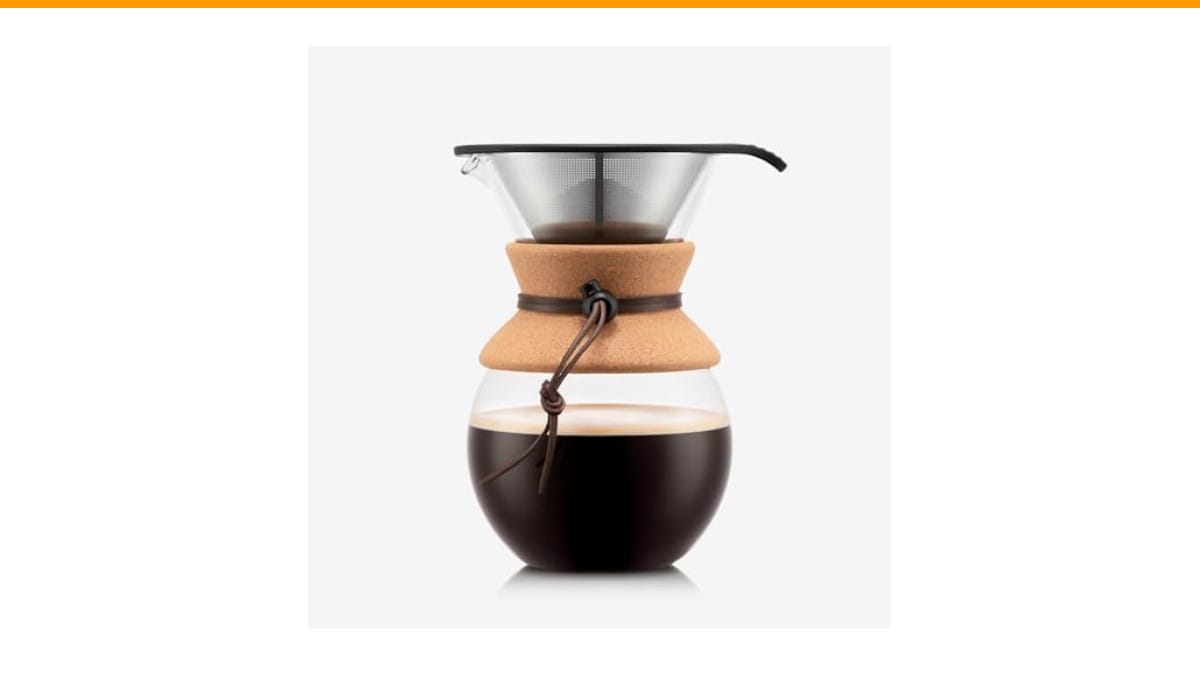
Bodum 34oz Pour Over Coffee Maker, High-Heat…
- Pour Over Coffee: Manual Pour Over Coffee Maker allows you to brew an excellent cup of Coffee in minutes
- Stainless steel: Includes a new and improved permanent, stainless steel mesh filter that helps extract your coffee's aromatic oils…
- Coffee Carafe: Made of durable, heat-resistant borosilicate glass with Cork Band detailing that is both functional and elegant; si…
As an Amazon Associate I earn from qualifying purchases.
If you’re using a glass carafe setup, the Bodum 34oz Pour Over Coffee Maker works well here. It uses a reusable stainless steel mesh filter, which lets more of the coffee’s natural oils through compared to paper. That means a slightly heavier mouthfeel and a bolder flavor profile right out of the gate.
Start With the Right Coffee-to-Water Ratio
Strength starts with the ratio. The standard pour over recipe is 1:16, which is one gram of coffee for every 16 grams of water. That produces a balanced, clean cup. For a stronger brew, you need to push that ratio down.
Try 1:14 or even 1:12. Here’s what that looks like in practice:
- 1:16 – Standard. 30g coffee to 480g water.
- 1:14 – Strong. 30g coffee to 420g water.
- 1:12 – Very strong. 30g coffee to 360g water.
If you don’t have a scale, use two tablespoons of coffee per six ounces of water as your starting point. That’s roughly a 1:15 ratio. Add another half tablespoon to push it toward 1:12. A scale is better, but volume measurements get you in the ballpark.
One thing to watch: dropping the water amount too much makes the coffee taste over-extracted and bitter. The coffee solubles need enough water to dissolve properly. I would not go below 1:12 for most beans. Dark roasts can handle it, but light roasts might turn harsh.
Grind Finer, But Not Too Fine
Grind size controls how fast water moves through the coffee bed. A finer grind means more surface area and slower flow. That translates to more extraction and a stronger final cup.
For a standard pour over, you want a medium grind, like coarse sea salt. To make it stronger, go one or two clicks finer on your grinder. Think table salt with a few larger pieces. The water will drain slower, pulling more flavor from the grounds.
There’s a limit though. If the grind is too fine, the water pools on top and the brew stalls. You end up with bitter, over-extracted coffee. The filter can also clog, which is a common issue with mesh filters like the one on the Bodum. If your brew time stretches past four minutes, your grind is too fine for that filter.
Start with a medium-fine grind and adjust based on taste. If the coffee tastes sour and weak, grind finer. If it tastes bitter and hollow, back it off a notch.
Raise the Water Temperature
Hotter water extracts more from the coffee grounds. The specialty coffee standard is 200°F, but you can push it higher for a stronger cup.
Use water just off a boil, around 205°F to 208°F. If you don’t have a thermometer, let the kettle sit for about 30 seconds after it boils. That gets you in the right zone. Boiling water at 212°F will scorch the grounds and produce a burnt taste, so don’t pour straight from a rolling boil.
This matters more for light roasts. Dense, lightly roasted beans need the extra heat to extract fully. Dark roasts are more soluble, so they do fine at lower temperatures. If you’re brewing a dark roast and it tastes bitter, drop the water temp before you change the ratio.
Keep in mind that a glass carafe loses heat faster than a ceramic or plastic brewer. Pre-heat your carafe with hot water before you start. Pour the rinse water out, then add your grounds. That small step keeps the slurry temperature stable through the brew.
Change Your Pouring Technique
How you pour affects extraction. A slow, controlled pour keeps the water in contact with the grounds longer. That increases strength without changing your ratio.
Use the pulse pouring method. Instead of one continuous pour, add water in three or four stages. Start with a bloom pour: just enough water to wet all the grounds, about twice the weight of the coffee. Wait 30 to 45 seconds for the coffee to degas. Then add the remaining water in two or three pours, waiting for the water level to drop about halfway between each.
This technique does a few things. It prevents the water from channeling through the coffee bed, which creates weak spots. It also keeps the slurry temperature higher, since you’re adding hot water in bursts rather than letting it cool in the carafe.
Stirring also helps. A quick stir with a spoon right after the bloom pour breaks up clumps and ensures all grounds are saturated. This is a small step that makes a noticeable difference in strength and consistency.
| Variable | Standard | Strong | Too Much |
|---|---|---|---|
| Coffee-to-water ratio | 1:16 | 1:12 to 1:14 | Below 1:11 |
| Grind size | Medium (sea salt) | Medium-fine (table salt) | Fine (espresso) |
| Water temperature | 200°F | 205°F to 208°F | 212°F (boiling) |
| Brew time | 3 minutes | 3.5 to 4 minutes | Over 4.5 minutes |
This table assumes you’re using a standard pour over dripper. The Bodum’s mesh filter flows faster than paper, so you may need to grind slightly finer to hit the same brew times.
One more thing: check your water. Hard water with high mineral content can mute flavors. Filtered water often makes a stronger-tasting cup because it lets the coffee’s compounds shine. It’s a cheap fix that changes everything.
Frequently Asked Questions
Why does my pour over coffee taste weak even with a fine grind?
Your ratio is probably off. Many people use too much water for the amount of coffee. Weigh your coffee and water. If you’re using 20g of coffee with 400g of water, you’re at 1:20, which is very weak. Drop the water to 280g for a 1:14 ratio and see the difference.
Does a metal filter make stronger coffee than paper?
Yes, noticeably. Metal mesh filters let fine coffee particles and natural oils pass through into your cup. Paper filters trap those oils and sediment. The result is a fuller-bodied, stronger-tasting brew. That’s why the Bodum’s reusable steel filter tends to produce a bolder cup than a paper filter dripper.
Should I use more coffee or less water for stronger coffee?
Both work, but they’re not identical. Adding more coffee increases strength and body. Reducing water makes the cup more concentrated but can lead to under-extraction if you go too low. A combination works best: bump the coffee dose slightly and reduce the water slightly, aiming for a 1:13 or 1:14 ratio.
Can I make a strong pour over without a scale?
You can, but it’s less consistent. Use two tablespoons of coffee per six ounces of water as a baseline. For a stronger cup, use three tablespoons. Volume measurements are less accurate because bean density varies, but they get you close enough to taste the difference.
Why does my strong pour over taste bitter?
Bitterness usually means over-extraction. Your grind is too fine, your water is too hot, or your brew time is too long. Try a coarser grind, drop the water temperature by five degrees, or shorten the total brew time to under four minutes. Adjust one variable at a time so you know what’s causing the problem.
What Actually Matters for a Stronger Cup
- Use a 1:14 ratio as your starting point, then adjust to taste. Don’t guess with scoops.
- Grind medium-fine, not fine. A stalled brew is worse than a slightly weak one.
- Heat water to 205°F for most beans. Drop it for dark roasts.
- Pulse pour in stages and stir after the bloom. Slow extraction beats fast dilution.
- Pre-heat your glass carafe. Cold glass steals heat from the slurry.
- Clean your gear regularly. Old coffee oils make everything taste flat and bitter. Check our cleaning guide for a quick fix.
- If your brewer is clogged or slow, that changes extraction. See how to fix a clogged machine if you suspect a problem.
Stronger pour over coffee doesn’t require fancy equipment. It requires paying attention to four numbers: ratio, grind, temperature, and time. Nail those and you’ll get a dense, rich cup every morning. If your current brewer has flow issues, that’s a different problem. Check our proper cleaning routine to rule that out first.
Products related to this article
Sponsored / affiliate links. As an Amazon Associate I earn from qualifying purchases. I may earn additional commission from eligible campaigns.
 HomeBeyond Espresso Coffee Maker 12 Cups, Classic Stovetop Espresso Maker, 600ml / 20oz Coffeemaker for Gas & Ceramic Stovetops (Silver)
 Belly Moka Coffee Maker Stovetop Espresso Maker 9 Cup Aluminum Moka Pot Percolator 15oz 450ml Easy Brewing for Electric Ceramic Stoves Home Camping Italian Cuban Café Classic Black
 Belly Moka Coffee Maker Stovetop Espresso Maker 6 Cup Aluminum Moka Pot Percolator 10oz 300ml Easy Brewing for Electric Ceramic Stoves Home Camping Italian Cuban Café Classic Silver