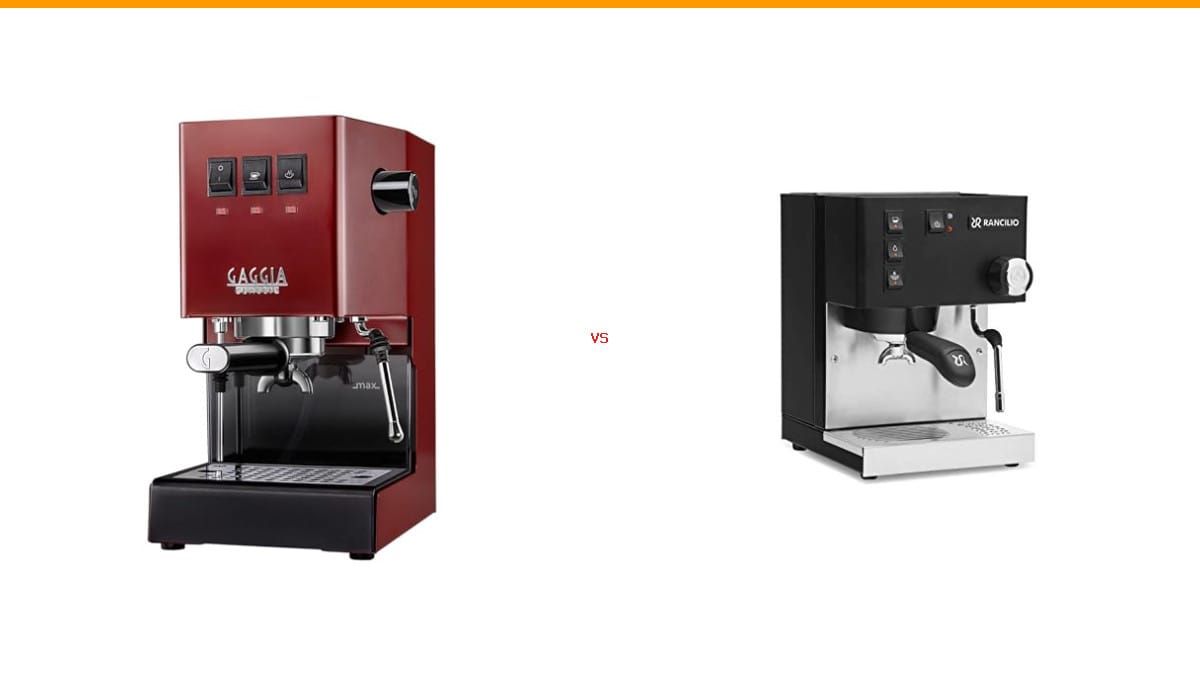
You’re staring at two of the most iconic home espresso machines ever made. Both have passionate fan bases. Both have been around for decades. And both will pull a genuinely good shot if you know what you’re doing. The real difference? It’s not the espresso. It’s what happens after you unbox them.
| Our Pick | Runner Up |

|

|
| Gaggia Gaggia RI9380/47 Classic Pro Espresso Machine,1.3liters, Cherry… | Rancilio Rancilio Silvia Espresso Machine, Black |
| See on Amazon | See on Amazon |
As an Amazon Associate I earn from qualifying purchases.
The Gaggia Classic Pro and Rancilio Silvia are rarely bought as-is. Most owners end up buying accessories — precision baskets, bottomless portafilters, PID controllers, better steam tips. That’s where the money goes, and that’s where your buying decision should focus. This comparison is about which machine has the smarter, cheaper, and more rewarding upgrade path.
Quick verdict: the Gaggia Classic Pro is the better investment for most home users because its modding ceiling is higher and its parts are cheaper. The Silvia is the better choice if you want a machine that works well with zero tinkering and you plan to keep it for a decade. Both are excellent. They just reward different kinds of owners.
Quick Verdict: Which Upgrade Path is Cheaper?
If you’re on a budget and want the most espresso quality per dollar spent, the Gaggia wins. The 9-bar OPV mod costs a few dollars and a half-hour of your time. The Silvia doesn’t need that mod, but you’ll likely want a PID kit for temperature stability, and those run significantly more. Add a precision basket and bottomless portafilter to both, and the Gaggia’s total upgrade cost is noticeably lower.
That said, the Silvia’s out-of-the-box performance is better. It has a larger brass boiler that holds temperature more steadily. The Gaggia’s aluminum boiler is smaller and swings in temperature unless you do the PID mod. So the real question is: do you enjoy tinkering, or do you just want to make coffee?
The Core Difference: Modding Philosophy vs. Out-of-the-Box Reliability
The Gaggia Classic Pro is a modder’s canvas. The Silvia is a purist’s workhorse. That’s not a knock on either machine. It’s the fundamental personality difference that shapes every accessory decision you’ll make.
The Gaggia’s aluminum boiler and 3-way solenoid valve are simple, proven parts. The machine is easy to take apart. YouTube is full of guides for every mod imaginable. The Rancilio Silvia, by contrast, is built like a small tank. Its brass boiler is heavier and more expensive to replace. But you rarely need to replace it. The Silvia just works.
Gaggia Classic Pro: The Modder’s Canvas
The Gaggia Classic Pro comes with a solid steel housing, a 58mm commercial portafilter, and a commercial 3-way solenoid valve. It’s made in Italy and it pulls a legitimate 9-bar espresso extraction. Out of the box, it’s a capable machine. But the stock steam wand is a known weak point — it works, but it’s not great for microfoam.
Here’s what most owners do within the first year: replace the steam wand tip with a two-hole or four-hole version from a Rancilio Silvia, install a 9-bar OPV spring, and upgrade to a precision basket. Each of these is cheap and easy. The Gaggia responds to these upgrades dramatically. The difference between the stock shot and a post-mod shot is night and day.
There’s also the Gaggiuino project — a full PID and pressure profiling setup that turns the Gaggia into something approaching a $2,000 machine. It’s not for everyone. It requires soldering and wiring. But the fact that it exists at all tells you something about the Gaggia’s ceiling.
The “Gaggiuino” Ceiling and the 9-Bar OPV Mod
The 9-bar OPV mod is the single best value in home espresso. The stock spring pushes about 12 bars of pressure. Swapping in a 9-bar spring costs almost nothing and immediately improves shot quality by reducing channeling and over-extraction. It’s a 20-minute job with basic tools.
The Gaggiuino project takes things much further. It adds PID temperature control, pressure profiling, and a shot timer with a display. It’s a serious electronics project. But for the hobbyist who enjoys that kind of work, the Gaggia becomes a genuinely high-end espresso machine for a fraction of the cost of a commercial unit.
Rancilio Silvia: The Purist’s Workhorse
The Silvia has been in production for over 20 years. That’s not a marketing claim — it’s a testament to a design that just works. The 12-ounce brass boiler serves both brew and steam temperatures. The steel case is sturdy and fits any kitchen. It’s compact at 9.5x11x13 inches.
Out of the box, the Silvia pulls better shots than the stock Gaggia. The boiler’s thermal mass means fewer temperature swings between shots. The steam wand is genuinely commercial-grade — it produces dry, powerful steam that makes latte art achievable with practice. You don’t need to mod the Silvia to get good results. You can just use it.
The catch is the temperature surfing. The Silvia’s single boiler heats up, then overshoots, then settles. To get consistent shots, you have to learn the machine’s rhythm — wait for the heating light to go off, wait a few seconds, then pull your shot. It’s a skill. Some people never master it. Others find it meditative.
The PID Reality: Why You’ll Probably Add One Anyway
Here’s the honest truth: most serious Silvia owners end up installing a PID kit. Temperature stability is the machine’s only real weakness, and a PID fixes it completely. But PID kits for the Silvia are more expensive than the Gaggia’s mods. They also require more careful installation because the boiler is harder to access.
Once you add a PID, the Silvia becomes a truly excellent machine. Consistent temperatures, repeatable shots, and a steam wand that can handle any milk drink. But now you’ve spent significantly more than a Gaggia owner who did the same upgrades.
Head-to-Head: The Accessory Ecosystem
Both machines use 58mm portafilters. That’s where the similarity ends. The basket depths are different, and that matters more than you’d think.
Portafilters & Baskets: The 58mm Trap
The Gaggia Classic Pro uses a 58mm portafilter, but the basket sits shallower than a standard commercial basket. That means many aftermarket baskets from VST or IMS won’t fit without modification. You’ll need to look for baskets specifically designed for the Gaggia, or buy a bottomless portafilter that comes with a compatible basket.
The Silvia also uses 58mm, but its basket is closer to commercial spec. Most aftermarket baskets fit without issue. That said, the Gaggia’s shallower basket isn’t a dealbreaker — precision baskets are available for it. You just have to know what you’re buying. Check the product description carefully before adding a basket to your cart.
Steam Wands: The Microfoam Showdown
The Silvia’s steam wand is the clear winner here. It’s a commercial-style wand that produces powerful, dry steam. You can texture milk for latte art without much practice. The Gaggia’s stock wand is weaker and produces wetter steam. It’s usable, but frustrating if you’re serious about latte art.
The fix is a cheap one. A Rancilio Silvia steam wand tip fits the Gaggia with a simple swap. It improves steam power noticeably. For a few dollars, the Gaggia closes most of the gap. But you shouldn’t have to mod a machine to get decent steam in the first place.
The Real Cost of Ownership: A 5-Year Breakdown
Let’s talk money. I’m not going to quote exact prices because they change constantly on Amazon. But I can give you a relative picture.
The Gaggia Classic Pro costs less upfront. Its upgrade path — 9-bar spring, steam tip, precision basket, bottomless portafilter — is cheaper than the Silvia’s equivalent path. A PID kit for the Gaggia is also less expensive than one for the Silvia. If you’re on a budget, the Gaggia is the clear financial winner.
But the Silvia holds its value better. Used Silvias sell for a higher percentage of their original price than used Gaggias. That’s because the brass boiler is seen as more durable and the machine has a reputation for longevity. If you plan to sell in five years, the Silvia will cost you less in depreciation.
Repair costs are different too. The Gaggia’s aluminum boiler is cheaper to replace. The Silvia’s brass boiler is more expensive, but you’re less likely to need to replace it. The Gaggia’s simpler design means cheaper parts and easier DIY repairs. The Silvia’s build quality means fewer breakdowns in the first place.
Here’s the honest math: over five years, the total cost of ownership is roughly similar. The Gaggia costs less to buy and upgrade. The Silvia costs more upfront but holds its value better. Choose based on your cash flow and whether you like to tinker.
The “First 3 Months” Shopping List
What do you actually need to buy right away? Here’s what most owners figure out within the first few weeks.
Gaggia Classic Pro owners: The 9-bar OPV spring is the first purchase. It’s cheap and transforms shot quality. Next, a precision basket — the stock one is mediocre. A bottomless portafilter helps you diagnose channeling and improve your technique. Finally, a steam tip upgrade if you care about latte art. That’s it. You can stop there and have a genuinely good machine.
Rancilio Silvia owners: You don’t need the OPV mod. The stock pressure is fine. A precision basket is a worthwhile upgrade. A bottomless portafilter is useful for technique. The steam wand is already excellent. The only big-ticket item is the PID kit, and that’s a “maybe” — many owners live happily without it by learning to temperature surf.
The Gaggia’s first-month shopping list is cheaper. The Silvia’s is optional. That’s the trade-off.
Who Should Buy Which (And What to Buy With It)
Budget buyer: Get the Gaggia Classic Pro. The initial price is lower, and the essential mods are cheap. Skip the Gaggiuino project unless you’re a serious electronics hobbyist.
Beginner: Get the Silvia. It’s more forgiving out of the box. The temperature surfing is a learning curve, but it teaches you the fundamentals of espresso extraction. The Gaggia’s stock temperature swings are harder to manage without mods.
Space-constrained: Both are compact. The Silvia is slightly smaller at 9.5x11x13 inches. The Gaggia is also small. Either fits on a standard counter.
Power user / hobbyist: Get the Gaggia. The modding community is larger and more active. The Gaggiuino project alone is a reason to choose it. You’ll learn more about espresso and electronics.
Latte art enthusiast: Get the Silvia. Its steam wand is superior out of the box. You’ll be pouring hearts and rosettas sooner.
Long-term owner: Get the Silvia. It’s built to last 20 years. The Gaggia is also durable, but its aluminum boiler is a weaker point than the Silvia’s brass one.
Before you buy either, make sure you have a proper grinder. Both machines will punish a cheap grinder with inconsistent shots. Read our espresso machine guide if you’re still deciding between semi-automatic and fully automatic. And pair either machine with a quality grinder — it’s the single most important accessory you’ll buy.
Frequently Asked Questions
Can I use the same accessories on both machines?
Partially. Both use 58mm portafilters, so some accessories like tampers and distribution tools are interchangeable. But baskets are not always compatible due to different depths. Steam wand tips are also not interchangeable between the two machines, though the Gaggia can accept a Rancilio-style tip as an upgrade.
Which machine is easier to maintain?
The Gaggia is easier to repair because its parts are simpler and cheaper. The aluminum boiler is less expensive to replace than the Silvia’s brass boiler. However, the Silvia requires less maintenance overall because its build quality is more robust. Regular descaling is essential for both.
Do I need a PID for either machine?
Not strictly. The Gaggia benefits more from a PID because its stock temperature stability is poor. The Silvia is more stable but still benefits from a PID for consistent shots. Many owners of both machines use them happily without a PID. It’s an upgrade, not a requirement.
Which machine has better resale value?
The Rancilio Silvia holds its value better. Its reputation for durability and the brass boiler make it a sought-after used machine. Gaggia Classic Pros also sell well, but at a lower percentage of their original price. If resale matters to you, the Silvia is the safer bet.
Final Verdict: The Better Investment
There’s no universal winner here. The Gaggia Classic Pro is the better investment for hobbyists, budget buyers, and anyone who enjoys making their machine better over time. The upgrade path is cheaper, the modding community is bigger, and the ceiling is higher. If you’re willing to spend an afternoon with a screwdriver, the Gaggia will reward you with espresso that rivals machines costing three times as much.
The Rancilio Silvia is the better investment for people who want a reliable, well-built machine that works out of the box. It’s more expensive upfront, but it holds its value better and its steam wand is superior. If you’d rather make coffee than mod a machine, the Silvia is the right choice.
My honest recommendation: most home baristas will be happier with the Gaggia Classic Pro. The cost savings are real, and the modding journey is part of the fun. But if you’re the kind of person who buys a tool and uses it for 20 years without ever opening the manual, the Silvia is worth every penny.
Whichever you choose, don’t forget about cleaning. Both machines need regular maintenance to perform well. Check our coffee maker cleaning guide to keep your machine in top shape. And if you’re also considering a Breville, our Breville grinder troubleshooting article might save you some headaches.
Products related to this article
Sponsored / affiliate links. As an Amazon Associate I earn from qualifying purchases. I may earn additional commission from eligible campaigns.
 HomeBeyond Espresso Coffee Maker 12 Cups, Classic Stovetop Espresso Maker, 600ml / 20oz Coffeemaker for Gas & Ceramic Stovetops (Silver)
 Coffee Espresso Machine Handle Replacement Parts, Cafe Bracket Handle for Lidl Silvercrest CM4621 CM4218 KF5002 KF500S Barista (for 51mm Portafilter Basket - Not included)
 Quick Heating Cup Warmer, Three Temperature Settings, Splashproof and Portable, for Coffee, Milk, Lightweight ABS Material