You just pulled your first shot of the morning, and it tastes a little flat. The crema is thin, and there’s a faint chalky aftertaste. You blame the beans, but the real culprit is sitting in your machine’s tank: the water.
Super automatic espresso machines are precision instruments. They grind, dose, brew, and steam with sensors and pumps that expect a specific water chemistry. Feed them the wrong water, and you’ll be shopping for a new brew unit or a descaling kit within a year. This guide covers the practical side of using filtered water, what it does to your warranty, the real cost difference over two years, and how to test your tap water without buying anything.

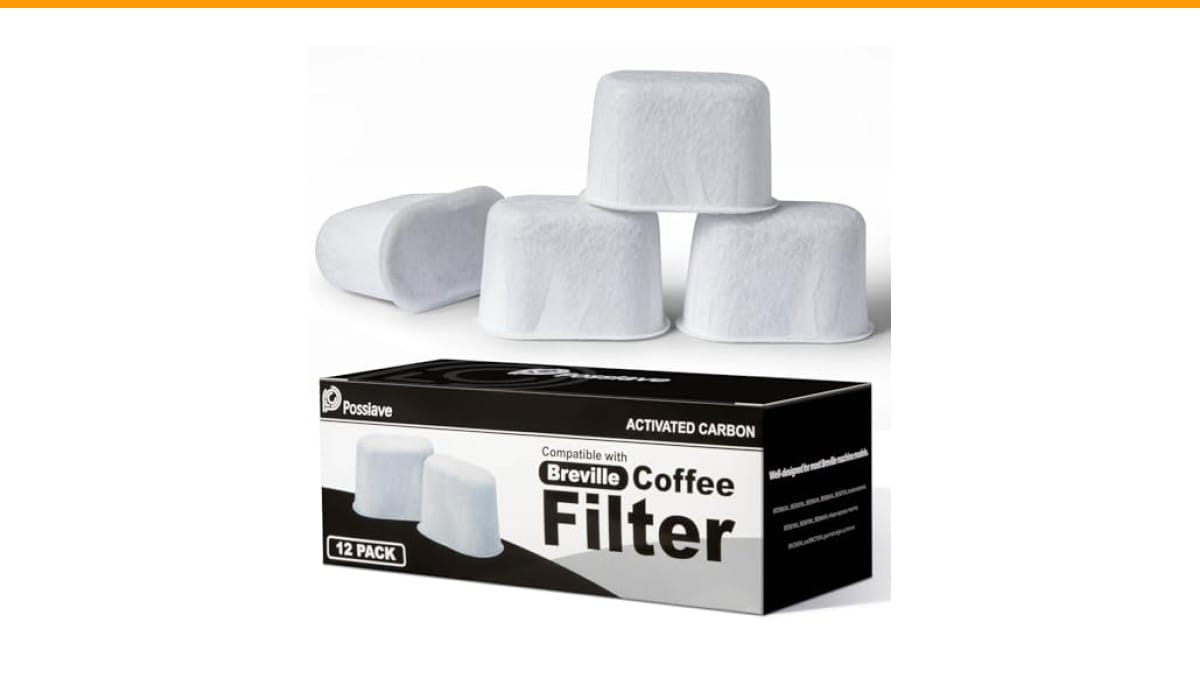
possiave
Possiave 12-Pack Water Filters Compatible with Breville…
- SUITABLE FOR MOST OF BREVILLE MACHINES - Well -designed for all Breville machine models: BES980XL, BES920XL, BES900XL, BES860XL, B…
- IMPROVE FLAVOR - Filter out chlorine, calcium, bad odors and impurities with purest coconut shell charcoal. The pore structure and…
- CONVENIENT TO STORAGE - For convenient storage, we provide individual package for each two water filters, which can also keep othe…
As an Amazon Associate I earn from qualifying purchases.
You’ll walk away knowing exactly what water to use, how to install it, and when the built-in filter is worth it versus a simple pitcher.
If your machine uses a removable water tank, a drop-in filter like the Possiave 12-Pack Water Filters Compatible with Breville BWF100 Machines is the easiest way to get consistent water without measuring anything. It fits most Breville tank models, uses coconut shell carbon to pull out chlorine and odors, and each filter is individually wrapped so the spares stay fresh. We’ll talk about whether that’s enough for your water later.
The Short Answer: Yes, But Only If You Choose the Right Filter
Yes, you can use filtered water in a super automatic espresso machine. But the type of filter matters more than the fact that you filtered it.
Running Brita-pitcher water through a $2,000 machine is generally safe, but it’s not the same as using a filter designed for espresso. Pitcher filters reduce chlorine and some taste compounds, but they barely touch water hardness. If your tap water is hard, a pitcher won’t stop scale buildup. You need a filter that softens the water, meaning it replaces calcium and magnesium ions with sodium or potassium ions.
The rule of thumb: any water you put in the tank should have a total dissolved solids (TDS) level between 80 and 150 ppm. That’s the sweet spot for flavor extraction and protecting the boiler from scale. Below that, you risk corrosion. Above that, you get scale.
Why Your Super-Automatic Machine is More Sensitive to Water Than You Think
Super automatics are different from manual espresso machines in one key way: they have a brew boiler that’s always on, and they use a pump that draws water directly from the tank. That means water sits in contact with metal parts at high temperatures for hours. Hard water doesn’t just leave a film; it deposits limescale on the heating element.
Scale is an insulator. A thin layer of calcium carbonate makes the boiler work harder to heat the same amount of water. That raises energy use, slows the brew time, and eventually causes the machine to throw an error code or shut down. A machine running on 300 ppm tap water often starts showing weak shots after about four months. The same machine on filtered water ran fine for over a year.
There’s also the auto-fill sensor. Many super automatics use a float or a magnetic sensor to detect water level. High mineral content can leave crusty deposits on that sensor, causing false readings. The machine thinks the tank is empty when it’s full, or vice versa. That’s a frustrating failure that has nothing to do with coffee quality and everything to do with water chemistry.
And then there’s the steam wand. Milk proteins and minerals bake onto the wand tip. Hard water makes that crust harder to wipe off, and over time, it can clog the steam nozzle. You’ll notice weaker steam pressure before you notice anything else.
The Real Difference Between Softening, Filtering, and Purifying
Most people use these words interchangeably. They are not the same, and the difference will save you money.
Filtering removes particles, chlorine, and some organic compounds. Activated carbon does this. It improves taste and odor but does not reduce hardness. A Brita pitcher is a filter.
Softening removes calcium and magnesium ions and replaces them with sodium or potassium. This is what prevents scale. Ion exchange resin does this. Most built-in espresso machine filters, like the Breville BWF100, use a combination of carbon and ion exchange resin. They soften and filter.
Purifying removes almost everything, including minerals. Reverse osmosis (RO) and distillation are purification methods. They produce water with a TDS close to zero.
Here’s the trap: zero TDS water is aggressive. It wants to dissolve minerals, and it will pull them from your machine’s metal boiler and brass fittings. That causes corrosion, pitting, and eventually leaks. Many manufacturers explicitly warn against using distilled or RO water without re-mineralizing.
So when someone tells you “filtered water is fine,” ask them what kind of filter. A carbon-only filter is fine for taste but useless for scale. You need a filter that softens, not just clarifies.
What Happens When You Use Unfiltered Tap Water (The Scale Timeline)
Let’s be concrete about what happens, week by week, with hard tap water (assume 250 ppm hardness).
- Month 1: No visible change. The machine’s descaling indicator hasn’t triggered yet. Shots taste fine.
- Month 3: The brew boiler starts accumulating scale. You might notice slightly longer brew times or a hotter shot. The machine’s thermal sensor is working harder.
- Month 6: The descaling light comes on. If you ignore it, scale hardens into a crust that chemicals struggle to dissolve.
- Month 12: The steam wand sputters. The pump sounds strained. The machine may start leaking from the brew unit because scale has worn the seals.
The cost of descaling chemicals is not the main issue. The cost is the labor and downtime. A thorough descale takes about an hour, and you have to run multiple cycles. If scale has already damaged the boiler, you’re looking at a $150 to $300 repair. On a super automatic, the brew unit itself is often the most expensive part, and scale is its worst enemy.
If you live in an area with soft water (under 60 ppm), you might get away with tap water. But most municipal water in the U.S. is moderately hard to hard. It’s not worth the risk on a machine that costs more than a used car.
The Hidden Dangers of Distilled or “Pure” Water (Why Zero TDS is a Trap)
It seems logical: no minerals means no scale. But pure water is a solvent. It wants to reach equilibrium, so it leaches ions from whatever it touches. In an espresso machine, that means the stainless steel boiler and brass group head start losing metal ions into the water.
This causes two problems. First, corrosion. Tiny pits form in the metal, and over time, those become leaks. Second, the water tastes flat. Coffee extraction relies on minerals to pull flavor compounds out of the grounds. Without any minerals, the water over-extracts bitter compounds and under-extracts the sweet ones. You get a sour, harsh shot that no bean can fix.
Some people use half distilled water and half tap water to hit a target TDS. That works, but it’s fiddly. You have to measure every time. A simpler approach is to use a filter that softens the water to a known range.
The bottom line: never put straight distilled or RO water in your super automatic. If you have an RO system at home, you need a re-mineralizing cartridge or a blend valve.
How to Test Your Water Hardness at Home in 2 Minutes
You don’t need a test kit to get a rough idea of your water hardness. This is a simple method for testing.
- Fill a clean, clear glass bottle with about 6 ounces of tap water.
- Add a single drop of liquid dish soap.
- Put the cap on and shake for 10 seconds.
- Look at the suds.
If you get a thick layer of fluffy suds, your water is soft. If you get few bubbles and the water looks cloudy or milky, it’s hard. The soap reacts with calcium and magnesium ions, so it takes more soap to create suds in hard water. This isn’t precise, but it tells you whether you need a softening filter.
For a real number, you can look up your city’s water quality report online. Most municipalities publish annual reports with hardness values in ppm or grains per gallon. One grain per gallon equals about 17 ppm. If your report says 10 grains, that’s 170 ppm, which is moderately hard.
Built-In Filter vs. External Pitcher: Which is Better for Your Machine?
This is the most common question we get. The answer depends on your machine’s design.
| Feature | Built-In Filter (e.g., BWF100) | External Pitcher (e.g., Brita) |
|---|---|---|
| Softens water | Yes (ion exchange resin) | No (carbon only) |
| Removes chlorine | Yes | Yes |
| Prevents scale | Yes | No |
| Requires measuring | No | Yes (fill pitcher, then tank) |
| Cost per year | ~$30–$60 (2–4 filters) | ~$50–$80 (pitcher + refills) |
| Fits in tank | Yes | No |
| Best for | Most super automatics with tank access | Machines with awkward tank placement |
For machines with a removable water tank, a built-in filter is almost always better. It softens the water, it’s always in the tank, and you don’t have to remember to fill a separate pitcher. The catch is that you have to replace it on schedule, usually every two months or 60 liters, whichever comes first.
If you have a plumbed-in machine, you’ll need an inline filter instead. That’s a different installation, but the principle is the same: carbon plus ion exchange.
One honest caveat: the built-in filter only works if you actually replace it. A filter left in place for six months becomes a bacteria farm. Set a reminder on your phone when you install a new one.
The Cost Analysis: Filter Replacement vs. Descaling Repairs
Let’s do the math over two years. Assume you have a $1,500 super automatic machine and you live in a hard water area (200 ppm).
Option A: No filter, descale every 3 months. A bottle of descaling solution costs about $15. You’ll need 8 bottles over two years. That’s $120. Plus, you spend about 8 hours total running descale cycles. If scale damages the boiler anyway, add $200 for a repair. Total: $320 and a lot of hassle.
Option B: Built-in filter, replaced every 2 months. A 12-pack of filters costs roughly $30–$40. Over two years, you’ll use 12 filters. That’s about $35 total. No descaling needed if you replace on schedule. Total: $35 and zero downtime.
The savings are obvious. Even if you buy the most expensive filters, you’re still ahead by hundreds of dollars. And you avoid the risk of a machine failure that could cost more than the filters.
There’s also the warranty angle. Most manufacturers, including Breville, require regular descaling as part of the warranty terms. If you use unfiltered hard water and never descale, they can deny a warranty claim. Using a filter doesn’t void the warranty; it actually helps you meet the maintenance requirements. But if you use distilled water and it corrodes the boiler, that’s not a manufacturing defect. That’s user error.
Does Filtered Water Actually Make Your Espresso Taste Better?
Yes, but not in the way you think. Filtered water doesn’t add flavor; it removes things that mask flavor.
Chlorine is the big one. Tap water with chlorine tastes sharp and slightly chemical. That taste carries straight into your espresso. Activated carbon removes chlorine almost instantly. The difference is noticeable in a side-by-side blind tasting. The filtered shot tastes cleaner, with more sweetness and less bitterness.
Hard water also affects extraction. Calcium and magnesium ions can bind with coffee compounds, making the extraction less efficient. You end up with a dull, flat cup. Softened water extracts more evenly, which brings out the origin notes in your beans.
But be careful: water that is too soft (under 50 ppm) produces a hollow, acidic shot. The ideal range for espresso is 80–150 ppm. Most built-in espresso filters land right in that zone, which is why they’re designed the way they are.
Step-by-Step: How to Install and Maintain Your Machine’s Filter
Installation is straightforward, but each machine is slightly different. Here’s the general process that works for most tank-based super automatics.
- Remove the water tank from the machine and empty it.
- Find the filter housing. It’s usually a cylindrical slot in the bottom or a bracket on the side.
- Rinse the new filter under running water for about 30 seconds. This activates the carbon.
- Insert the filter into the housing. Push down until it clicks into place.
- Fill the tank with fresh water and reinsert it into the machine.
- Run a water-only cycle (no coffee) to prime the filter. Discard that water.
- Set a reminder for 2 months or the manufacturer’s recommended interval.
Maintenance is just as important. Never let the filter dry out. If you leave the machine unused for more than a week, remove the filter and store it in a sealed plastic bag in the fridge. When you come back, soak it in water for 10 minutes before reinstalling.
Also, check the auto-fill sensor area for any scale buildup when you replace the filter. A quick wipe with a damp cloth keeps the sensor working properly.
If you notice your machine leaking water from the base, that might not be a filter issue. Check our guide on automatic espresso machine leaking water to troubleshoot before you pay for a repair.
Frequently Asked Questions About Water and Super-Automatic Machines
Can I use bottled spring water in my super automatic espresso machine?
Yes, but check the label for mineral content. Some spring waters are very hard (over 200 ppm) and will cause scale just like tap water. Look for a brand with a TDS between 80 and 150 ppm. If the label doesn’t list TDS, assume it’s not ideal.
How often should I replace the water filter in my espresso machine?
Most manufacturers recommend every 2 months or after 60 liters of water, whichever comes first. If you use your machine heavily (more than 4 shots a day), replace it monthly. A filter that’s past its prime stops softening water effectively, and scale starts building up again.
Will using filtered water void my espresso machine warranty?
No. Using filtered water is the opposite of voiding your warranty; it helps you meet the maintenance requirements. What voids a warranty is neglecting descaling or using water that damages the machine, like distilled water. Keep your descaling schedule regardless of the filter.
Is it safe to use water from a refrigerator dispenser?
Refrigerator filters are usually carbon-only. They remove chlorine and taste issues but don’t soften water. If your fridge has a built-in water softener, that’s different, but most don’t. Treat fridge water like pitcher water: fine for taste, not enough for scale prevention.
Can I use water from a reverse osmosis system?
Only if you re-mineralize it. RO water has a TDS near zero, which is corrosive to your boiler. You need to blend it with tap water or use a re-mineralizing cartridge. Without that, you’re trading scale for corrosion, and corrosion is harder to fix.
The Bottom Line: Your Action Plan for Perfect Water
- Use a filter that softens, not just filters. Carbon-only is not enough.
- Test your water hardness with the soap method or check your city’s report.
- Aim for a TDS between 80 and 150 ppm.
- Never use distilled or straight RO water.
- Replace your filter every 2 months, and set a phone reminder.
- Run a water-only cycle after installing a new filter.
- Keep your descaling schedule, even with a filter. It’s cheap insurance.
Your machine is a precision tool. Give it clean, slightly mineralized water, and it will reward you with consistent shots for years. Skimp on water, and you’ll spend that money on repairs and descaling chemicals. The choice is simple.
For more on keeping your machine running smoothly, read our comparison of automatic espresso machine vs semi models to see which maintenance style fits your routine. And if you’re hearing strange noises, check our guide on automatic espresso machine making loud noise before assuming it’s a water problem.
Products related to this article
Sponsored / affiliate links. As an Amazon Associate I earn from qualifying purchases. I may earn additional commission from eligible campaigns.
 Coffee Espresso Machine Handle Replacement Parts, Cafe Bracket Handle for Lidl Silvercrest CM4621 CM4218 KF5002 KF500S Barista (for 51mm Portafilter Basket - Not included)
 SOLUSTRE Electric USB Coffee Cup Warmer with Temperature Settings Portable Milk and Beverage Heating Coaster for Office Desk Small Lightweight Design Easy to Clean Surface Multi Functional
 Linnkyfloa Coffee Espresso Maker Handle Replacement for Stovetop Moka Pot or Percolator, Black Plastic for Spare Part Compatible with Italian(9-12 Cup)