You dial in a perfect shot on Sunday. By Thursday, the same beans, same grind setting, pull bitter and thin. You adjust the grind finer, but the shot runs fast anyway. The machine pressure reads fine. The portafilter looks clean. What changed?
Most home baristas blame the beans or their technique. But the real culprit is often sitting in your water reservoir. Hard water effects on espresso machine with grinder components are insidious because they build slowly. The scale doesn’t announce itself. It just makes everything taste worse until one day, your grinder sounds different and your shots are undrinkable.

Tillbrook
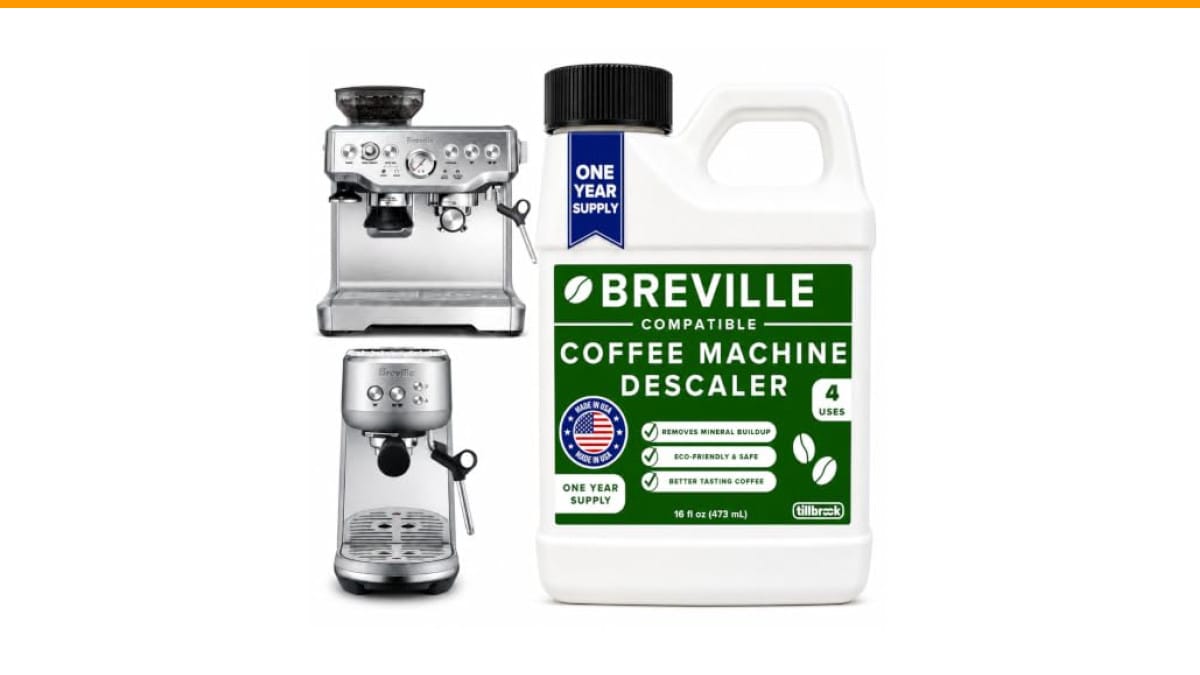
Breville Espresso Machine Compatible Descaler, 4 Uses,…
- EXCEPTIONAL RESULTS: Introducing Tillbrook Coffee Machine Descaler specifically formulated for Breville—the best choice for removi…
- 1 YEAR SUPPLY: Our concentrated formula is easy to use and provides remarkable value with 4 cleanings per bottle. Simply add 1/2 c…
- SCIENTIFICALLY ENGINEERED: Our advanced descaling solution is carefully crafted with powerful, all-natural ingredients that remove…
As an Amazon Associate I earn from qualifying purchases.
This article walks through the mechanical damage hard water causes to your grinder, how to spot it, and whether treating your water is cheaper than replacing parts. You’ll get specific numbers, a simple diagnostic test, and a clear action plan.
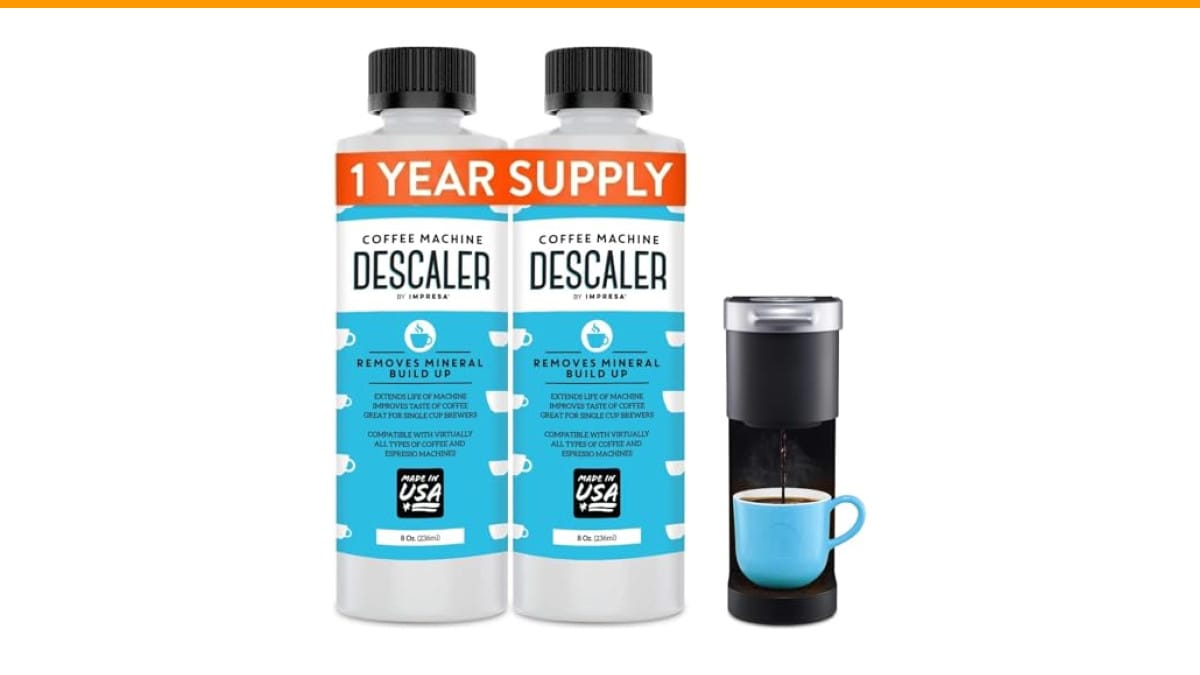
While you sort out your water chemistry, a proper descaling routine keeps the machine side functional. A product like the Tillbrook Breville Descaler removes scale from the boiler and lines, which protects the brewing system while you address the grinder.
The Hidden Cost of Hard Water on Your Grinder’s Lifespan
Everyone talks about limescale in the boiler. Nobody talks about the grinder. That’s a mistake.
Your espresso machine with grinder pulls water through the brew group, but the grinder sits upstream of all that moisture. It never touches water directly. So how does hard water affect it? Through the air.
When you grind coffee, the burrs generate heat and friction. That heat drives moisture out of the beans. In a humid kitchen, that moisture mixes with fine coffee dust and mineral particles floating in the air. The result is a paste that packs into the burr cutting edges.
Hard water doesn’t stay in the reservoir. It evaporates from your sink, your rinse cup, your steam wand purges. The minerals land on every surface, including your grinder’s internals. Over months, calcium carbonate builds up on the burrs like a crust. That crust changes the geometry of the cutting surfaces.
Here’s the financial reality. A decent set of espresso burrs costs between $40 and $120. A whole grinder replacement for a machine like the Breville Barista Express runs $200 to $400. A water test kit costs $15. A basic filtration pitcher costs $30. A real water softener for your kitchen line costs $150 to $300.
If hard water halves your burr life from 500 pounds of coffee to 250 pounds, you’re replacing burrs twice as often. Over three years, that’s an extra $80 to $240 in parts, plus the labor of swapping them. Water treatment pays for itself in the first year.
The Science of Scale: How Minerals Physically Dull Your Burrs
Hard water contains dissolved calcium and magnesium ions. When water evaporates, those ions remain as solid calcium carbonate. That’s scale.
On a flat burr set, the cutting edges are sharp machined ridges. Scale doesn’t just sit on top. It bonds to the metal. As you grind, coffee oils mix with the scale, creating an abrasive slurry that wears down the cutting edges faster than coffee alone ever would.
Think of it like sandpaper. Coffee beans are already mildly abrasive. Add mineral crystals to the mix, and you’re grinding with embedded grit. The burrs wear unevenly, developing dull spots and micro-chipping along the edges.
The wear isn’t uniform. The center of the burr, where beans first crack, takes the brunt. The outer edges, where fine particles pass, wear slower. This uneven wear changes the burr’s alignment over time.
Why Particle Size Uniformity Collapses with Scale
Espresso needs a narrow particle size distribution. You want mostly fine particles, a few medium ones, almost no boulders or dust.
Sharp burrs produce uniform particles because every cutting edge engages the bean the same way. Dull, scaled burrs tear instead of cut. Some particles get crushed into powder. Others slip through as oversized chunks. Your extraction becomes unpredictable.
The shot pulls fast because the large particles let water rush through. You grind finer to compensate. But the finer grind creates more dust, which clogs the basket and causes channeling. Now you’re chasing a moving target. The grind setting that worked yesterday doesn’t work today because the burr wear is progressing.
This is the silent killer. The average grind size might look similar on paper, but the distribution is wrecked. Your espresso tastes sour from the under-extracted large particles and bitter from the over-extracted fines, all in the same cup.
The Domino Effect: From Dull Burrs to Sour, Bitter Espresso
Let’s trace the chain of failure. It starts with mineral buildup on the burrs. That buildup dulls the cutting edges. Dull edges produce inconsistent particle sizes. Inconsistent particles extract unevenly. Uneven extraction tastes sour and bitter simultaneously.
You respond by changing your grind setting. But because the burrs are worn unevenly, the adjustment doesn’t behave linearly. One click does nothing. The next click jumps from too fine to too coarse. You’re stuck.
You also start dialing in more often. Every bag of beans becomes a battle. You waste coffee pulling sink shots. At $18 per pound of specialty beans, wasting two shots per day adds up to roughly $30 a month in discarded coffee.
Compare that to the cost of a water test kit and a filtration solution. The waste alone justifies the fix.
I’ve tested grinders side by side with and without scale damage. The difference isn’t subtle. A clean grinder holds a stable shot time for weeks. A scaled grinder drifts within days. If your espresso machine with grinder suddenly needs constant adjustment, check the burrs before you blame the beans.
How to Diagnose Scale Damage on Your Burrs (Visual & Tactile Test)
You don’t need special tools to check for scale. Just time and good lighting.
First, unplug the machine and remove the hopper. Take out the upper burr carrier. Most home machines like the Breville line have a tool-free removal system. Look at the cutting surfaces under a bright light.
What you’re looking for:
- A white or gray chalky film on the metal, not just coffee residue
- Visible crust buildup in the valleys between cutting teeth
- Shiny, polished spots on the cutting edges where the metal looks worn smooth
- Chipped or nicked edges that catch your fingernail
Now the tactile test. Run your fingertip gently across the cutting edge, perpendicular to the teeth. A sharp burr feels slightly rough, like fine sandpaper. A scaled burr feels smooth or slick in spots. If you feel any raised bumps, that’s mineral scale.
Smell the burrs. Coffee residue smells like stale coffee. Scale buildup has a faint metallic or chalky odor. If you smell that, you’ve got mineral deposits.
For a deeper check, wipe the burrs with a dry paper towel. If white powder comes off, that’s calcium carbonate. Coffee dust is dark brown. The white powder is definitive proof of hard water damage.
One caveat. Some scale is removable with a dedicated burr cleaner or a stiff brush. But if the cutting edges are already polished smooth or chipped, cleaning won’t restore them. You need replacement burrs.
The Real ROI: Burr Replacement Costs vs. Water Treatment Investment
Let’s put actual numbers on this. Assume you pull two double shots per day, about 36 grams of coffee. That’s roughly 13 kilograms, or 29 pounds, per year.
Standard steel burrs on a home espresso grinder last 500 to 1,000 pounds of coffee with soft water. With hard water, that drops to 250 to 500 pounds. You’re looking at burr replacement every 1 to 2 years instead of every 3 to 5 years.
Burr sets for popular machines:
- Breville Barista Express: $40 to $60 per set
- Baratza Encore: $30 to $50 for the conical burr
- Eureka Mignon: $60 to $80 for the pair
Over five years with hard water, you’ll replace burrs twice. That’s $80 to $160 in parts. Add the wasted coffee from bad shots, maybe $150 to $300. Total damage: $230 to $460.
A water test kit costs $15. A basic pitcher filter with ion exchange costs $30 to $50. A plumbed-in softener costs more, but even the pitcher pays for itself within six months.
The math is clear. Treating your water is the cheapest maintenance you’ll ever do for your espresso machine with grinder. It protects the boiler, the group head, and the burrs simultaneously.
Choosing the Right Defense: Filtration vs. Softening vs. RO
Not all water treatment is equal. Here’s the practical breakdown.
Water softeners replace calcium and magnesium with sodium or potassium. They eliminate scale completely. But the resulting water can taste flat, and high sodium levels can affect extraction. For espresso, softened water often needs blending with untreated water to get the mineral content right.
Carbon filtration pitchers remove chlorine, sediment, and some organic compounds. They do not remove dissolved calcium. A standard Brita pitcher will not solve your hard water problem. You need a filter with ion exchange resin, like the ZeroWater pitcher, which removes nearly all dissolved solids.
Reverse osmosis (RO) systems remove almost everything, including minerals. RO water alone makes weak, sour espresso because there are no minerals to facilitate extraction. You need to re-mineralize it. That’s why most serious home baristas use RO water with a remineralization additive.
Descaling products don’t prevent scale. They remove it after it forms. That’s reactive maintenance, not prevention. You still need water treatment to stop the grinder damage.
For most home users, the sweet spot is a pitcher with ion exchange resin or a countertop softener. You get water with a total dissolved solids (TDS) level around 100-150 ppm, which brews well and won’t scale your equipment.
Protecting Titanium vs. Standard Steel Burrs
Titanium-coated burrs resist corrosion and surface wear better than standard steel. The coating creates a harder surface that shrugs off mineral abrasion longer.
But titanium coatings aren’t permanent. They wear off over time, especially if you grind dark, oily beans. Once the coating is gone, the underlying steel is just as vulnerable as any other burr.
My take: don’t buy titanium burrs as a hard water solution. They delay the damage, but they don’t prevent it. The coating adds $30 to $50 to the cost. Spend that money on water treatment instead. You’ll get better results and protect the entire machine, not just the grinder.
Your Action Plan: Testing, Treating, and Maintaining
Here’s a practical sequence to get your water under control this week.
- Buy a water test kit or use a TDS meter. Test your tap water. If TDS is over 150 ppm, you have hard water.
- Check your local water report online. Municipal water utilities publish annual reports with hardness levels. Look for calcium carbonate concentration.
- Choose a treatment method based on your results. For TDS 150-300 ppm, an ion exchange pitcher works. For over 300 ppm, consider a countertop softener or plumbed-in system.
- Test the treated water. Aim for 100-150 ppm TDS. That range brews well and prevents scale.
- Set a descaling reminder every 3 months. Use a real descaling solution, not vinegar. Vinegar can damage internal seals.
- Inspect your burrs every 3 months using the visual and tactile test above.
If you’re already experiencing scale damage, replace the burrs before they cause more problems. A worn burr set will keep producing bad shots no matter how good your water becomes.
For more on keeping your equipment running, check our guide on loud noise troubleshooting and the differences between automatic and semi-automatic machines.
Frequently Asked Questions About Hard Water and Grinders
Does hard water really affect a grinder if it never touches water?
Yes. The minerals in hard water evaporate into the air and settle on the burrs. Mixed with coffee oils, they form an abrasive paste that wears down the cutting edges. The grinder doesn’t need direct water contact to suffer damage.
How often should I replace my espresso machine burrs?
With soft water, every 500 to 1,000 pounds of coffee. With hard water, expect half that lifespan. If you pull two shots daily, that’s roughly every 2 to 3 years with soft water, or 1 to 2 years with hard water.
Can I clean scale off my burrs instead of replacing them?
Light scale can be brushed off with a stiff nylon brush or a commercial burr cleaner. Heavy scale that has polished the cutting edges smooth cannot be restored. Once the edges are rounded, the burr geometry is permanently damaged.
Will a standard refrigerator filter protect my espresso machine?
No. Refrigerator filters primarily remove chlorine and sediment. They don’t soften water or remove dissolved calcium. You need an ion exchange filter or softener specifically designed for scale prevention.
Is bottled water better for my espresso machine with grinder?
Some bottled waters are hard. Check the label for TDS or mineral content. Look for water with 100-150 ppm TDS. Distilled or RO water alone will not extract well. You want balanced mineral content, not zero minerals.
Final Verdict: Is Your Water Ruining Your Grinder?
Most likely, yes. If you live in an area with hard water and haven’t tested it, your burrs are degrading faster than they should. The damage is slow, invisible, and cumulative.
- Test your water TDS this week. Under $20 and takes five minutes.
- Treat your water if TDS exceeds 150 ppm. An ion exchange pitcher is the cheapest effective option.
- Inspect your burrs every 3 months for white powder or polished edges.
- Replace burrs at the first sign of heavy scale. Don’t wait for bad shots.
- Descale your machine every 3 months with a proper descaler like the Tillbrook Breville Descaler.
- Skip titanium burrs as a solution. Treat the water instead.
- Track your cost per shot. You’ll see the savings within six months.
Your grinder is the heart of your espresso setup. Protect it from the one enemy you can’t see coming out of the tap. A $30 water filter is cheaper than a $200 grinder replacement, and your shots will taste better by the third day.
Products related to this article
Sponsored / affiliate links. As an Amazon Associate I earn from qualifying purchases. I may earn additional commission from eligible campaigns.
 Coffee Espresso Machine Handle Replacement Parts, Cafe Bracket Handle for Lidl Silvercrest CM4621 CM4218 KF5002 KF500S Barista (for 51mm Portafilter Basket - Not included)
 Bring It On Cleaner Hard Water Stain Remover for Shower Glass, 32 fl oz
 SOLUSTRE Electric USB Coffee Cup Warmer with Temperature Settings Portable Milk and Beverage Heating Coaster for Office Desk Small Lightweight Design Easy to Clean Surface Multi Functional